TLDR; Need an SEO stack that gets work shipped, not just planned.
Pick connected systems that turn search data into priorities, briefs, optimized drafts, prioritized fixes, and reporting, with human review still in the loop. Skip flashy features, don’t overrate content scores, don’t ignore technical SEO, and don’t trust fully automated publishing at scale. The best platform supports content, technical SEO, reporting, and AI search readiness in one workflow.
Most SEO teams don’t struggle because they lack ideas. The real problem is messier. Good ideas get stuck in clunky workflows, with a keyword list in one tool, content briefs in docs, audits buried in another dashboard, and reports showing up only after the damage has already hit traffic. That’s why modern SEO strategy tools matter.
The best platforms do more than help teams plan. They help teams get things done. Research turns into briefs, briefs into pages, audits into fixes, and reporting into the next move. A real workflow. That change matters even more now because AI-driven search keeps changing the rules, and teams need speed while still keeping control over what happens next.
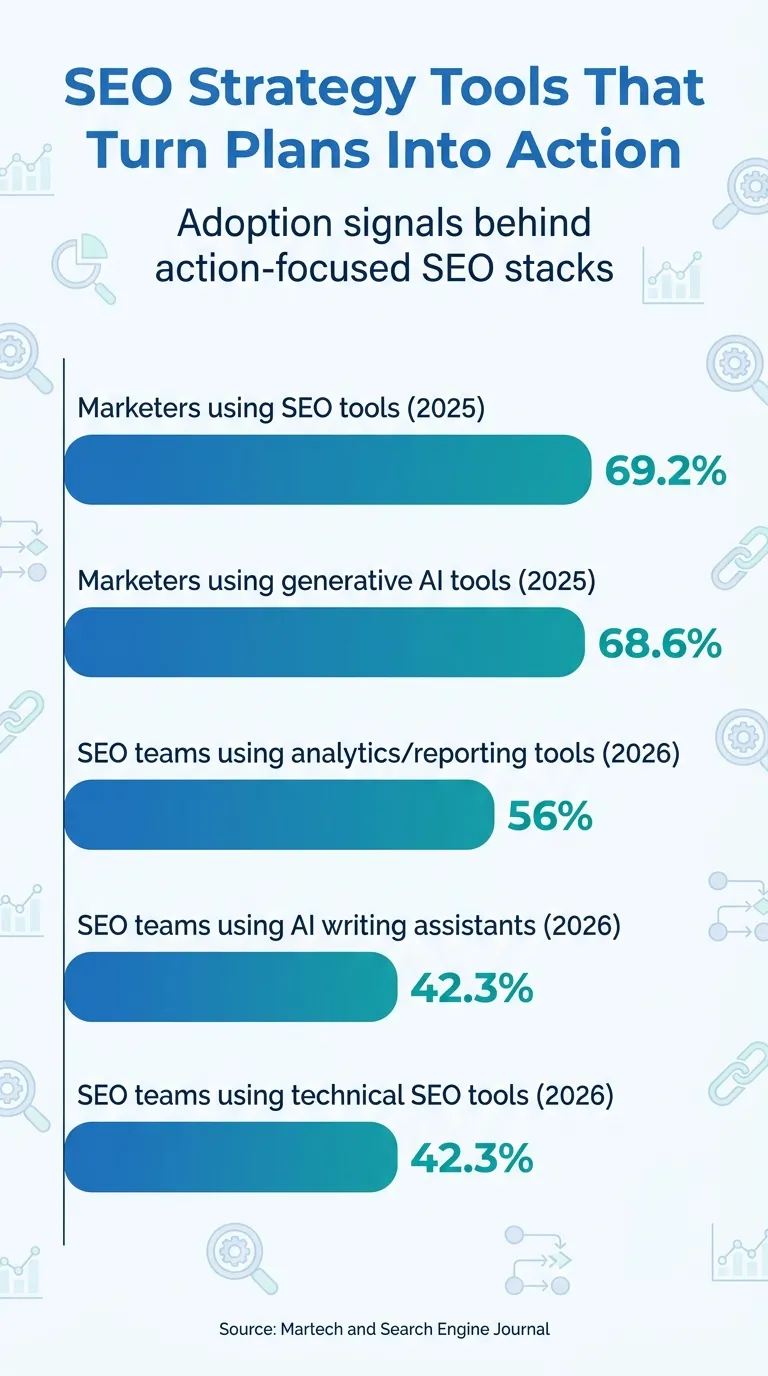
Recent data shows this is already the new normal. 69.2% of marketers use SEO tools and 68.6% use generative AI tools according to Martech’s 2025 stack survey (Martech). The question is no longer whether teams should use tools. What matters is which SEO content tools and which SEO automation platform actually keep work moving.
This guide covers what action-focused SEO stacks look like, which features matter most, how teams can avoid common mistakes, and how to build a system that works for agencies, content teams, and WordPress-based workflows.
Why SEO strategy tools matter more than planning alone
A strategy helps only if a team can really put it to work. A lot of SEO setups still split tasks across separate tools: one for keyword research, another for content scoring, a crawler to find issues, and a spreadsheet to track fixes. In day-to-day work, that slows teams down.
The market is moving toward connected systems. According to Search Engine Journal, 56% of SEO teams use analytics and reporting tools, while 42.3% use AI writing assistants and 42.3% use technical SEO tools (Search Engine Journal). That points to something pretty simple: winning teams need measurement, content support, and technical action in one working process.
Our research shows that 95% of B2B marketers say their organizations use AI-powered applications.
Content Marketing Institute research team, Content Marketing Institute Tweet
| Metric | Figure | Year |
|---|---|---|
| Marketers using SEO tools | 69.2% | 2025 |
| Marketers using generative AI tools | 68.6% | 2025 |
| SEO teams using analytics/reporting tools | 56% | 2026 |
| SEO teams using AI writing assistants | 42.3% | 2026 |
| SEO teams using technical SEO tools | 42.3% | 2026 |
That helps explain why strong SEO strategy tools now work more like operating systems than basic research apps. They do more than research. They help teams make decisions faster and cut the busywork that can bury the real priorities.
The core features that turn SEO plans into work
When comparing tools, focus less on huge feature lists and more on how well they fit the workflow. What matters most is how smoothly a platform helps the team manage five steps without friction.
1. Turn search data into clear priorities
Good tools should cluster keywords, group intent, and show which topics matter first. Simple, useful, and helpful for agencies and lean teams that can’t chase every opportunity, so they can focus on the key work first. Teams comparing workflows can also review How to Choose SEO Keyword Tools for Automation for a more detailed breakdown of research-focused systems.
2. Turn priorities into briefs
A lot of stacks break here. A plan on its own isn’t enough because writers still need structure, search intent, entities, internal link ideas, and clear page goals. For a closer look at content-first platform choices, this guide on AI SEO platform picks for content optimization is a useful next read.
3. Turn briefs into optimized drafts
SEO content tools should help with outlines, draft generation, and optimization without pushing teams into robotic writing. The goal is faster first drafts, really, not something content teams can publish without thinking. Some teams also compare AI-powered content tools beyond first drafts when evaluating how much editing support they still need after generation.
4. Turn audits into fixes by priority
The best systems don’t dump hundreds of errors on your team. They sort issues by impact, and that’s where automation really saves time.
5. Turn results into next steps
Dashboards matter only when they lead to action, not on their own. Reporting should show what changed, what worked, and what needs attention next week instead of making everyone wait until next quarter.
How an SEO automation platform changes daily workflow
An SEO automation platform closes the gap between knowing and doing. Lots of teams already know what needs fixing, but the handoff slows everything down and stretches the work out longer than it should. Automation helps cut that delay.
Take a content team that spots 40 older blog posts with falling clicks. Without automation, someone has to export rankings, check Search Console, review on-page gaps, build fresh briefs, update internal links, and track progress manually from start to finish. That adds up fast. With a connected setup, the platform can surface, sort, and organize much of that work on its own.
Hands-off SEO isn’t the goal. Secondary industry data says 93% of marketers edit AI-generated content before publishing (Digitaloft). The point is simple: use AI where it helps teams move faster, then keep human review in place where quality matters. That comes up in SEO work every day. People still need to guide brand voice, accuracy, and business priorities.
Technical SEO is a practical place to start. Teams can get quick wins by automating site checks and reporting first, since those tasks repeat all the time and are easy to postpone when other work piles up. Then they can move into content refreshes, schema help, and page-level optimization. On bigger sites, the workflow gets more complex. This related guide on best AI SEO tools for technical SEO automation goes deeper into that side of the stack. Larger organizations may also compare approaches in Enterprise SEO Automation for Large Content Teams when evaluating how workflow automation scales.
Common mistakes when choosing SEO content tools
A lot of buyers choose tools because the demo looks impressive. It looks great in the room. That can lead to five common mistakes, and most of them don’t show up until later, when the team is trying to use the tool day after day.
First, they buy for features instead of workflow. A tool may offer AI writing, audits and reports. That sounds useful. But if the team still has to copy everything into other systems, execution slows down, handoffs get messy and the shiny feature list stops mattering.
Second, they put too much weight on content scores. A page can score well and still miss real search intent. Better SEO content tools help teams understand what the page needs to do, not just how many related terms it includes.
Third, they overlook technical foundations. People may treat content and technical SEO as separate worlds, and that split creates missed opportunities. Search visibility depends on crawlability, structure and content quality working together, not on one piece alone.
Fourth, they expect fully automatic publishing to work safely at scale. That rarely goes well. Search keeps changing, and AI-generated drafts still need review for accuracy, tone and trust, especially at volume.
Fifth, they forget AI search visibility. Search Engine Journal has noted that enterprise SEO is moving toward AI visibility monitoring, multimodal search and automated reporting tied to newer search experiences (Search Engine Journal). If a platform only supports old-school rankings, it may already feel limited.
Agencies juggling lots of sites run into a similar version of the same issue. best SEO automation tools for agencies managing 100+ client sites looks at that scaling problem from a different angle.
How SEO strategy tools fit AI search and GEO
SEO strategy tools now need to do more than track blue-link rankings. They should help teams get content ready for AI summaries, answer engines, and the wider work tied to Generative Engine Optimization.
That shift is showing up in budgets. 69% now have budget allocated for AI search optimization, up from 38% in 2025 (SEOFOMO Survey). That’s a big jump, and it happened fast.
SEO tools for analyzing search patterns, recommending keywords, optimizing content for search engines, and predicting ranking improvements (41%).
Content Marketing Institute research team, Content Marketing Institute Tweet
For SEO teams, a strong platform should support entity coverage, clean structure, citation-friendly formatting, and technical readiness, especially as content needs to perform across more than one kind of search experience. It should also help with content refreshes, not just new publishing. In a WordPress workflow, older posts can deliver the quickest gains when teams update them with stronger structure and clearer intent.
A simple way to evaluate your stack before you buy
Before you commit to a new tool, test it against your real workflow. Start with five simple questions.
Check whether it can cut the time between keyword insight and a finished content brief, because that gap is where slow tools can start dragging the whole process down.
Then see if it can turn technical findings into clear actions, instead of stopping at surface-level errors that leave your team to work out what matters on their own.
Also, make sure it supports human review rather than pushing raw AI output straight to publish.
Next, look at how it presents performance and ask whether that view actually helps your team decide what to do next, not just report numbers without useful direction.
After that, check if it supports where search is going, including AI search visibility and GEO-style content structure.
If the answer is no to two or more of those questions, your current stack may be adding more work than it saves.
A resource hub like SEO Bot Software can help with that too. The site focuses on reviews and insights around AI-powered SEO automation, technical SEO audits, content generation and GEO strategy, which makes it useful for teams comparing connected workflows instead of isolated tools. Teams focused on lean publishing operations may also find SEO Workflow Automation for Lean Content Teams useful when reviewing day-to-day execution processes.
Frequently Asked Questions
What are SEO strategy tools?
SEO strategy tools help teams move from research to action. They usually cover keyword analysis, content planning, optimization, auditing, reporting, and workflow tracking. The best ones connect those steps so teams do not lose time moving between separate apps.
How are SEO content tools different from general AI writing tools?
SEO content tools are built around search intent, page structure, optimization, and ranking goals. General AI writing tools can create text, but they often lack SERP context, internal linking guidance, and SEO-specific workflows. That makes them less useful for search-led publishing.
What should I look for in an SEO automation platform?
Look for a platform that reduces manual work in audits, content briefs, refreshes, and reporting while still letting humans review output. It should support prioritization, not just task volume. It should also fit your CMS and team process.
Are SEO strategy tools worth it for small teams?
Yes, especially for lean teams. Small teams often benefit the most because automation removes repetitive work that would otherwise eat up the week. Even automating audits and reporting first can free time for strategy and content quality.
How can I compare platforms without wasting months on the wrong one?
Start with your actual bottleneck. If briefs are slow, test briefing and content workflows. If updates are lagging, test audit and prioritization features. SEO Bot Software is one practical place to compare tools and use cases when you want a WordPress-friendly view of AI-driven SEO automation without starting from scratch.
Can one platform really cover content, technical SEO, and AI search readiness?
Not every platform does it well, but some are moving in that direction. The strongest options combine audits, content support, automation, and reporting in one system. If you are researching that type of connected setup, an AI SEO automation reviews platform can help you narrow down options based on workflow fit.
Put your SEO plan into action
The big idea is simple: strategy without execution turns into organized delay. SEO strategy tools now need to do more than surface opportunities. They should help teams move faster, cut handoffs, and avoid manual cleanup.
The right tools should connect research, content, technical fixes, reporting, and AI search readiness in one workflow. Human judgment still needs to stay in the loop, because automation should take repetitive work off the team’s plate, not take over the smart decisions that really matter.
When a team is reviewing its stack, it helps to start small. Pick one clear area first. Technical audits, briefing, or content refreshes all make sense. Then measure the time saved and see whether the platform helps the team make better decisions instead of just producing more output. Then build from there.
The teams that win won’t be the ones with the most dashboards. They’ll be the ones with the clearest link between insight and action. Strong SEO content tools and the right SEO automation platform exist for that reason, and that difference shapes how fast teams can move.