TLDR; The article explains that enterprise SEO automation helps large content teams handle scale by taking repetitive work off their plates. That includes technical audits, keyword clustering, internal linking, content briefs, and reporting, so teams can spend less time on manual tasks and more time on higher-value work.
It also explains why automation matters right now: SEO drives a large share of enterprise traffic. At the same time, AI is changing search visibility, and manual workflows can quickly become expensive bottlenecks.
The piece also makes clear that AI-generated content still needs human review, governance, and clear ownership. That protects quality, trust, and brand consistency.
Its main recommendation is practical: start with one measurable workflow, connect automation to technical SEO and AI visibility KPIs, and build a stack the team will actually use.
Large content teams usually run into a simple problem, and it can get messy fast. As a site grows, keeping SEO work consistent gets much harder. One team handles briefs. Another does the writing. Editors step in to fix quality issues, while SEO managers juggle audits, internal links, schema, reports, and all the smaller follow-ups, which can stack up faster than expected. Before long, those small tasks become a real bottleneck.
That’s why Enterprise SEO automation matters so much right now. It helps teams move faster, but it’s also about creating a system that helps large groups publish better content, catch technical issues early, and respond to AI search changes before teams burn out, which happens more often than many people expect. Automated SEO handles repeatable work, so people can spend more time on strategy, quality, and brand voice.
In this guide, readers will learn what enterprise SEO automation actually means and where it brings the most value. Which workflows should be automated first? They’ll also see how large teams can avoid common mistakes, and why AI visibility, technical SEO, and governance now need to be part of the same discussion. That’s often where bigger teams start getting clearer, more consistent results.
Why automation is now part of Enterprise SEO
At the enterprise level, SEO is no longer just a single-channel task. It usually works more like an operating system that supports content, technical health, reporting, and search visibility at the same time, which is a lot for any team to handle. Research shows that SEO drives 53.3% of all website traffic for enterprises on average (Gitnux). That is a huge share, and it helps explain why larger brands are investing more in it.
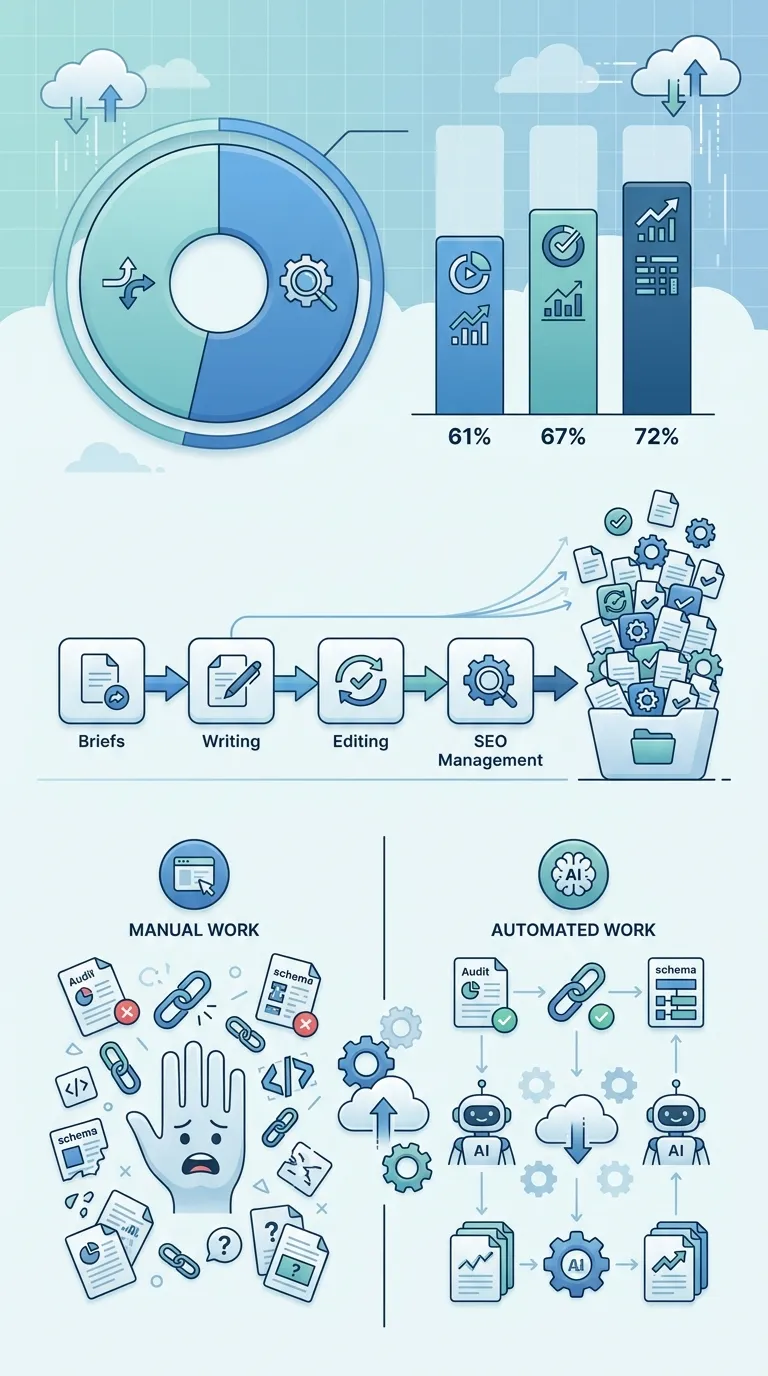
The scale problem is just as obvious. According to Tenet, 67% of SEOs say AI’s top benefit is automating repetitive, low-value tasks, and 61% of marketers now see AI as a core part of SEO strategy (Tenet). When teams are responsible for hundreds or even thousands of pages that need audits, updates, and optimization, manual work usually stops being practical, and many teams simply cannot keep up.
| Enterprise SEO metric | Value | What it means |
|---|---|---|
| Share of enterprise website traffic from SEO | 53.3% | Organic search remains a major growth channel |
| Marketers who see AI as core to SEO | 61% | Automation is moving into core workflows |
| SEOs who value AI for repetitive tasks | 67% | Teams want time back for strategy and QA |
| Enterprises prioritizing topic clusters | 72% | Content planning is becoming more structured |
These numbers make the move toward automated SEO pretty easy to understand. It seems to come from real complexity and the daily workload teams are dealing with, not just hype. If you want a broader look at tool categories, we covered that here: Top Automated SEO Tools of 2026: Revolutionizing Digital Marketing.
What large content teams should automate first
Not every SEO task needs automation right away. The best place to start is usually the work that repeats, follows clear rules, and is easy to track. For most teams, that means technical audits, keyword clustering, internal link suggestions, content briefs, on-page checks, and recurring reports, basically the routine work.
The time savings can be huge. Sedestral reports that SEO automation saves 15 to 25 hours per week per professional. It also found that manual audits can drop from 20 hours to 20 minutes. Weekly keyword research can shrink from 12 hours to 30 minutes (Sedestral). Those gains often matter most when one SEO lead supports several writers, editors, and product teams at the same time.
A simple rollout often looks like this:
1. Automate discovery
Tools that crawl the site are really helpful. They flag broken pages, find duplicate metadata, and spot indexing problems you’ll probably want fixed. Simple, fast, and useful.
2. Automate planning
Group keywords and map search intent, since that usually helps. Then create content briefs with clear headings and entity suggestions, so planning is faster.
3. Automate optimization support
Suggest internal links, schema options, image alt gaps, and content refresh priorities. Fixes will likely show up sooner.
4. Automate reporting
For stakeholders, it often helps to pull rankings, traffic, AI visibility, and technical health into one dashboard. That keeps everything in one place, which usually makes it easier to review.
Teams wanting a more future-focused overview can also read Automated SEO Software: Key Trends Shaping the Future in 2026 if that feels helpful.
AI content, human review, and the governance layer
One of the biggest mistakes in enterprise SEO is thinking automation takes people out of the process. It doesn’t. More often, it gives teams better systems and clearer workflows, which is usually the real issue. Tenet found that 87% of businesses use AI to create SEO content, and 68% of marketers report better ROI after adopting AI-powered SEO strategies (Tenet). That sounds promising, of course. But content volume alone probably won’t protect rankings.
Search behavior is changing quickly. AI Overviews now appear in as much as 47% of Google search results, and zero-click searches have climbed to 58% in the U.S.. When AI Overviews appear, click-through rates can drop by 34.5% (Tenet). Large teams do need to publish fast. Just as important, they need content structured clearly enough to be cited in AI Overviews, summarized in search results, and trusted by readers and search engines.
According to Search Engine Journal, enterprise teams now need stronger systems for AI visibility monitoring and content optimization at scale (Search Engine Journal). Lumar also says generative AI works best when paired with strong editorial review, QA, and expert oversight (Lumar). That’s hard to argue with.
Common mistakes include publishing raw AI drafts, skipping fact checks, ignoring duplicate topics, and letting multiple teams go after the same keyword set. On big teams, those issues are easy to miss. Good enterprise SEO automation should include approvals, templates, style controls, and clear ownership, so everyone knows who reviews what and when.
The technical SEO bottlenecks automation can fix
Content is only one part of the picture. A surprising number of enterprise sites still get stuck on the same technical basics. Gitnux says that 78% of enterprises struggle with site speed optimization, and just 35% of enterprise homepages fully implement schema markup (Gitnux). Those two issues alone can slow crawling, make pages harder for search engines to understand, and create a worse experience on the homepage and important landing pages. That gets frustrating quickly.
Automated SEO is especially useful here. Large teams can use it to monitor crawl errors, check schema, manage redirect patterns, and find orphan pages, including the easy-to-miss issues that tend to build up. It can also flag pages that slowly drift away from standards over weeks or months. Instead of waiting for a quarterly cleanup, teams can often catch problems much earlier, which usually means less cleanup later.
For content-heavy WordPress sites, the impact is often even bigger. Fast-moving editorial teams can create technical issues without noticing. A publishing workflow that checks metadata, canonicals, heading structure, structured data, and internal links before launch can prevent a lot of rework later. In many cases, it also helps the publishing process run more smoothly.
If your team is comparing audit-focused solutions, we covered that here: The Best SEO Audit Tools of 2026: Free vs Paid Options Compared.
New KPIs: from rankings to AI visibility
Enterprise SEO teams used to focus on rankings, clicks, and conversions. Those still matter, of course, but they no longer show the full picture. AI search has added another layer, with citation readiness, passage extraction, topical authority, and visibility in AI-generated results often becoming the biggest shift.
According to Tenet, in January 2025 AI Overviews appeared in 30% of all search results and 74% of problem-solving queries (Tenet). That means informational content teams need to track more than traditional rank positions. They also need to see whether pages are actually being surfaced and used by AI systems, not just indexed, even though indexing still matters.
A stronger KPI set for enterprise teams now includes:
AI visibility share
How often your brand shows up in AI Overviews and similar AI answers (you’ll probably see it there).
Citation-ready formatting
Whether pages use clear headings, concise answers, broad entity coverage, you know, the basics, and structured data too.
Content decay and refresh rate
Which pages are probably losing authority in search, I think. Or losing freshness over time.
Workflow efficiency
How long it takes to turn an idea into an optimized post is usually the main bottleneck.
This shift also connects to Generative Engine Optimization, or GEO. For brands watching this area, SEO Bot Software covers AI-driven SEO automation, technical audits, and GEO strategy in a way that often works with modern content operations.
How to build an automation stack that your team will actually use
The best automation stack usually isn’t the one with the longest feature list. It’s the one your team can use every week without getting lost, because that’s often the real test. A good place to start is the biggest bottleneck in the workflow. That might be audits. It could be brief creation, content production, reporting, e-commerce page optimization, or something similar.
When you compare tools, a short checklist usually helps more than a huge requirements doc. Keep it practical:
- Can it connect to your CMS and analytics stack?
- Does it support permissions and approvals?
- Can it scale across lots of authors, teams, or business units?
- Does it help with schema, internal linking, and technical QA?
- Can it report on rankings and AI visibility?
- Does it reduce manual work without hurting quality?
For agencies and large publishers, modular systems often work better than one giant platform. Some teams may prefer a separate audit tool, an AI writing assistant, a content optimizer, and a reporting layer. Other teams want one dashboard that covers a lot, and that can work too. In most cases, the right setup depends on how the team really works, not what the sales page promises, and that’s easy to forget.
For niche use cases, especially with larger product catalogs, we covered that here: SEO automation tools for e-commerce catalogs.
Frequently Asked Questions
What is enterprise SEO automation?
Enterprise SEO automation is the use of software, AI, and workflow tools to handle large-scale SEO tasks. This includes audits, keyword clustering, internal linking, reporting, content briefs, schema checks, and content refresh planning. It helps big teams work faster and stay more consistent.
How is automated SEO different from basic SEO tools?
Basic SEO tools often show data and leave the next step to the user. Automated SEO tools go further by triggering actions, creating recommendations, syncing workflows, and reducing manual steps. They are better suited for large sites and distributed teams.
What tasks should a large content team automate first?
Start with repeatable tasks that eat up time every week. Good first choices are technical audits, keyword grouping, content brief generation, internal linking suggestions, and recurring reporting. These areas usually show value quickly and are easier to measure.
Can AI-generated content work for enterprise SEO?
Yes, but only with strong human review. AI can speed up research, drafting, and optimization, but enterprise teams still need editors, subject experts, and QA checks. Without that layer, content quality and brand trust can suffer.
How do you measure ROI from enterprise SEO automation?
Track both efficiency and outcomes. Look at hours saved, faster publishing cycles, lower audit time, more content output, and better reporting speed. Then connect those gains to rankings, traffic, conversions, and AI visibility over time.
Where can teams compare automated SEO platforms and GEO-focused tools?
Teams that want practical reviews and strategy content can use resources like SEO Bot Software, which focuses on AI SEO, technical automation, tool comparisons, and Generative Engine Optimization topics. It is especially useful for marketers who want to compare workflows rather than just feature lists.
Put automation to work without losing quality
Enterprise SEO automation usually works best when it’s used like a team system, not a shortcut. The goal isn’t to publish more pages just to do it. It’s to help the content team manage high-value work at scale, with fewer mistakes, clearer workflows, and better results.
The numbers show that too. For a lot of teams, AI is already a core part of SEO strategy. Automation can save hours each week, and technical checks happen faster, which honestly makes a real difference. Reporting gets easier too. And while AI search keeps growing, large brands need closer control over how content is structured, cited, and trusted, so everything stays consistent.
One useful way to do this is to start small. Pick a workflow that’s slowing the team down, automate that part, and measure what changes. Then improve the process before moving on to the next step. Keeping it simple early on usually helps. Once that starts working, Enterprise SEO feels a lot less messy and more like a repeatable system for growth, probably with less stress too.
That’s the real promise of Automated SEO for large content teams: less busywork, more clarity, and better visibility across traditional search and AI-driven discovery. In practice, that often gives teams more time for strategy, content quality, and fixing issues before they spread.