TLDR; AI content platforms in 2026 are full workflow systems: research, planning, drafting, optimization, QA, reporting, and team collaboration in one place.
GEO is now a priority. The best platforms help content rank in search and appear in AI answers with clear structure, trust signals, and citation-friendly formatting. Multimodal creation, built-in humanization and QA, and cloud governance matter too. Choose for workflow fit, not feature count. Prioritize research depth, GEO support, multi-format output, editing control, and performance feedback.
AI content creation platforms are moving fast in 2026, but the biggest change isn’t just faster writing. The real shift is in how teams are using an AI content creation platform. The market is moving away from single-use generators and toward connected systems that help teams research, plan, create, optimize, review, and measure content in one workflow.
That matters now because search has changed. Marketers aren’t writing only for blue-link rankings anymore. They also need content that AI search experiences can understand, cite, and reuse. Put simply, an AI content creation platform now has to support both classic SEO and geo optimization.
Recent market data shows why this space feels so urgent. The global generative AI in content creation market was valued at $19.75 billion in 2025 and is projected to reach $24.08 billion in 2026, on the way to $143.09 billion by 2035, according to Precedence Research (Precedence Research). Those are big numbers. For digital marketers, SEO teams, and agencies, that growth points to a clear shift: these tools are becoming part of the content operating system. Teams no longer need to decide whether to use them. Now they need to figure out which trends matter most and how to build a workflow that still sounds human.
AI Content Creation Platform Systems Are Becoming End-to-End
One of the clearest 2026 trends is the rise of all-in-one platforms. A few years ago, lots of teams used one tool for ideation, another for briefs, another for optimization, and another for reporting, which led to messy handoffs and extra friction. Not ideal. Today, stronger platforms bring those steps into one workspace. They support topic clustering, search intent research, first drafts, on-page suggestions, refresh workflows, and performance tracking.
The adoption data makes that shift easy to understand. Once AI becomes a normal part of marketing teams, people stop looking for a fun writing toy and start looking for something more reliable. A more steady system.
For SEO teams, the biggest benefit is operational. A connected AI content creation platform cuts duplicate work and keeps research, optimization, and publishing closer together, which leads to cleaner briefs and fewer weak pages slipping through. If you want a closer look at how these tools fit content workflows, this guide to AI SEO platform picks for content optimization is a useful next read.
The best platforms in 2026 aren’t replacing editors. They help editors spend less time fixing structure problems and more time improving accuracy, tone, and originality. Teams comparing solutions can also review AI-powered content tools beyond first drafts to see how workflow-focused systems are evolving.
AI Content Creation Platform Geo Optimization Is Moving Into the Core Workflow
A big trend for 2026 is AI writing merging with geo optimization. It’s a real shift because content now has to work in two places at once: standard search results and AI-generated answers. That raises the bar. Platforms get judged less on how fast they draft and more on how well they help pages become clear, quotable, trustworthy, and easy for systems to use.
Good geo optimization features include entity support, question-based outlining, citation-friendly formatting, FAQ planning, summary generation, and topic coverage analysis. It’s practical stuff. Teams want a page that answers real questions clearly enough for AI systems to use without confusion.
So now, teams using AI content creation platforms should build around a short process:
1. Start with questions, not just keywords
Find the exact problems your audience is asking about. Keywords still matter. What those questions cover and how much depth they need matters even more now.
2. Structure for answer extraction
Use short sections, clear headings, comparisons, definitions, and simple examples.
3. Strengthen trust signals
Add expert-backed points, current data, and real-world use cases. Simple stuff. They help content feel more dependable to both users and machines.
4. Review for human clarity
Multimodal Creation in an AI Content Creation Platform Is No Longer Optional
In 2026, text is still the biggest use case, but the market is clearly moving toward multimodal output. The strongest platforms can handle blog posts, images, short-form video scripts, voiceover drafts, social clips, product copy, and repurposed content from one source brief. That shift matters for agencies and content teams because audience attention is now split across many formats.
Precedence Research notes that text generation held the largest share in 2025, but stronger multimodal capabilities across text, images, video, and audio are also driving market growth (Precedence Research). That matches what many marketers are seeing day to day: one campaign brief now needs to turn into many assets, fast.
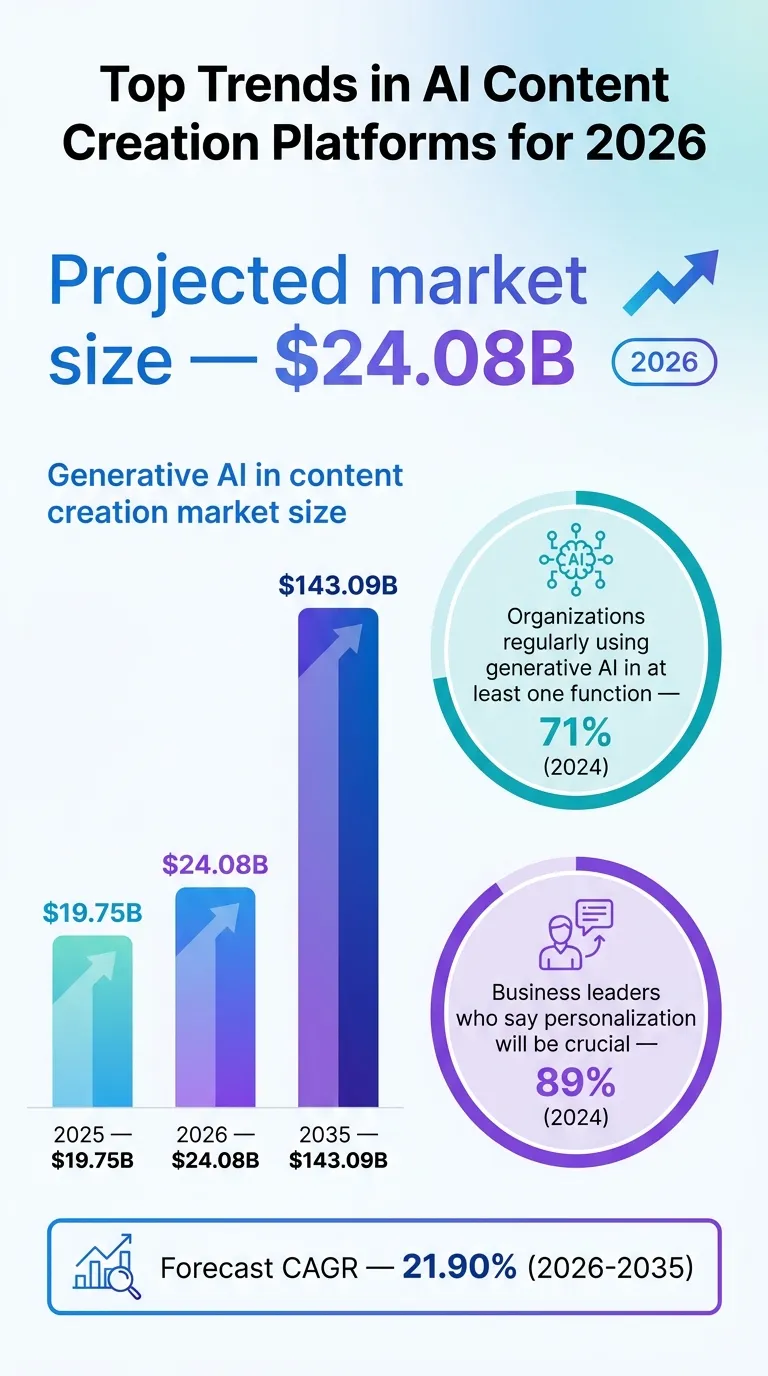
Key numbers shaping AI content creation platform strategy
| Metric |
Value |
Year |
| Generative AI in content creation market size |
$19.75B |
2025 |
| Projected market size |
$24.08B |
2026 |
| Forecast market size |
$143.09B |
2035 |
| Forecast CAGR |
21.90% |
2026-2035 |
| Organizations regularly using generative AI in at least one function |
71% |
2024 |
| Business leaders who say personalization will be crucial |
89% |
2024 |
The numbers above show broad, global growth tied to business demand for personalization and scale. That demand is a big reason multimodal platforms matter. Marketers can take one message and adapt it for different channels without rebuilding the strategy from scratch every time.
Teams can make a common mistake by trying to chase every format at once. Better teams start with one source asset, like a detailed article, then repurpose it into email copy, short videos, FAQs, and social posts. That keeps messaging consistent, saves time, and makes it easier for campaigns to grow across channels. Teams investing more heavily in video workflows may also benefit from 2026 Video SEO Optimization Using AI Tools.
Quality Control and Humanization Are Becoming Product Features
Another clear trend in 2026: AI content quality checks are moving into the platform itself. That answers a real problem. Publishing faster became easy. Publishing reliable, readable, and distinctive content at scale did not.
Platforms are adding built-in review layers for tone, factual consistency, duplication risk, readability, and brand voice alignment. Some also flag sections that feel too generic or miss search intent. That’s good news. For agencies managing many writers or clients, quality control cannot live only in a shared doc and one final editor pass anymore. Teams need those checks earlier, while the work is still taking shape.
Humanization gets more practical here too, and a lot less gimmicky. In strong workflows, the platform helps a team reach a usable draft faster. Then people step in. They still adjust examples, claims, transitions, and brand perspective. The final result should feel useful and natural instead of machine-smoothed, especially when several people touch the same piece before it goes live.
If your team is dealing with review bottlenecks, AI content creation QA for search teams offers a deeper look at what to check before publishing. In most cases, the best 2026 setup is simple: let AI handle repeatable structure, and let humans handle judgment. Teams balancing SEO with readability may also find AI Content Humanizer Tips Without Losing SEO useful.
Cloud, Collaboration, and Governance in an AI Content Creation Platform
A less flashy trend is picking up fast, and it still matters a lot: cloud-based deployment, team collaboration, and governance controls. Precedence Research found that the cloud segment dominated the market in 2025 (Precedence Research). That shift matters because content creation is more of a team effort now, not solo work. SEO leads, editors, designers, strategists, and clients may all need access to the same workflow.
Cloud-first platforms make it easier for teams to manage templates, approvals, content libraries, and role-based permissions. They also help agencies and multi-site brands move faster. In 2026, this operational layer matters nearly as much as writing quality. Pretty close. It helps teams publish in a steady way instead of relying on one power user.
Governance matters too. As AI content scales, brands need clearer rules for fact-checking, compliance, brand tone, and content ownership. That stands out even more in regulated industries and at larger agencies. When a platform shows review history and makes reviews repeatable, it can save teams a lot of trouble later. Teams handling policy concerns can review Ethics and Regulations in AI Content Generation: What You Need to Know for 2026 for a broader industry perspective.
For many teams, a platform stops feeling like just software here. It starts working more like content infrastructure.
What Smart Teams Should Look for Next
If you’re choosing an AI content creation platform in 2026, focus on workflow fit, not feature count. A long feature list can look impressive, but that doesn’t mean the output will be useful. What helps most is a platform that matches how the team already works and where things tend to slow down.
Start with five checkpoints:
Research depth
The tool takes audience questions, entities, and search intent, then turns them into a more clear brief.
Geo optimization support
It helps shape pages for AI search visibility and regular rankings too.
Multi-format output
One asset can become several ready-to-use assets without losing meaning.
QA and editing controls
Can your team check accuracy, tone, and originality as part of the process?
Reporting loop
Publishing decisions should link back to performance so teams can clearly see what needs improving.
For teams weighing options, platforms like SEO Bot Software fit into the broader shift toward AI-driven SEO automation, especially when technical SEO, content generation, and GEO strategy all need to work together at once. The main lesson is simple: don’t buy the most tools. Teams need to close workflow gaps.
Frequently Asked Questions
What is an AI content creation platform?
An AI content creation platform is software that helps teams plan, draft, optimize, edit, and sometimes publish content using AI. In 2026, the best ones go beyond writing and support research, workflow management, QA, and performance feedback.
Why does geo optimization matter for AI content platforms?
Geo optimization matters because search is no longer only about ranking web pages. Content now also needs to be clear enough for AI systems to summarize, cite, and surface in answer-based experiences. A platform that supports geo optimization can help teams format and structure content for that reality.
Are AI content creation platforms replacing human writers?
No. They are changing the job, not removing the need for people. AI is very good at speeding up repeatable tasks, but human writers and editors are still better at judgment, originality, nuance, and brand voice.
What features should agencies prioritize first?
Agencies should usually prioritize shared workflows, QA controls, content briefs, and reporting before chasing flashy generation features. Those are the features that help teams scale without losing quality. A platform with solid governance often creates more long-term value than one with the fastest draft tool.
How can smaller teams use these trends without buying too much software?
Start with the biggest bottleneck. If research is slow, fix research first. If output lacks consistency, focus on templates and QA. Smaller teams can also study tools and workflow ideas through resources like SEO Bot Software, which covers AI-powered SEO automation and content operations in a practical way.
What is the biggest mistake marketers make with AI content in 2026?
The biggest mistake is treating AI like a shortcut instead of a system. When teams publish unedited drafts, ignore search intent, or skip QA, quality drops fast. Better results usually come from using AI to support a clear process, not replace one.
Where the Market Is Heading Now
The top trends in AI content creation platforms for 2026 are moving in the same direction: deeper integration, better structure, stronger QA, and closer alignment with geo optimization. Speed still matters, but it is no longer the main selling point. The platforms that stand out now help teams create content that performs across search, AI answers, and multiple formats without losing trust.
The market is growing quickly, adoption is already mainstream, and expectations keep rising. Readers want useful content. Search engines want clarity. AI systems want structured, dependable information. Teams need a workflow that works for all of them.
A practical next step is to review the current process from brief to publish. Look for the biggest slow point. Then choose one improvement that helps the workflow connect more clearly. Maybe the team needs better QA. Maybe it needs stronger geo optimization. Or maybe one platform can bring content and SEO work together. Start there. Measure the result. Then build on what actually works. In 2026, thoughtful systems will beat rushed output almost every time.