TLDR; Need the best SEO audit tool fast? Start with trusted data.
Google Search Console and PageSpeed Insights stay in the stack for first-party data. Ahrefs comes out on top for backlink analysis, content gaps, and competitor research; Semrush fits broader reporting and team collaboration. Many teams pair one with Screaming Frog for technical crawling. The smartest 2026 setup is lean: trusted data, crawling, clear prioritization, solid reporting, plus audits for AI visibility, structured content, and automation that speeds fixes.
Marketers are rethinking their audit stack fast. The latest shift isn’t just about catching broken links or missing tags anymore. It’s really about moving faster, seeing more of the whole picture, and getting a clearer sense of which issues usually need attention first. That wider view is likely part of why this feels different right now. Recent industry reporting shows AI is taking on a bigger share of routine SEO work, while teams are also managing visibility across traditional search, AI answers, and content systems. According to Sintra AI in a report published May 26, 2026, AI SEO audit tools now handle about 44% of SEO tasks (Sintra AI). At the same time, broader market data suggests software demand is rising, with more teams moving past a one-tool setup, and that shift is happening very fast.
It matters now because free and premium SEO audit tools aren’t as close as they used to be. Google SEO tools still give you the clearest first-party data, but paid platforms like Ahrefs and Semrush are pulling ahead on deeper technical analysis, better reporting, and more workflow automation. If you’re a digital marketer, agency lead, or part of a content team trying to cut through the noise and move faster, this guide looks at what’s changing, which tools stand out, and how to pick a stack that fits how you work. It sounds simple enough, even if it often gets messy in practice.
Why SEO audit tools are becoming a bigger priority
The main shift isn’t that marketers suddenly want more software. It’s that websites have become much harder to monitor by hand. A single audit might now look at crawl health, internal linking, Core Web Vitals, schema, indexation, content quality, and even how a brand shows up in AI-driven results, which is a lot to cover at once. So more teams are paying for faster work, wider coverage, and fewer gaps than manual work usually leaves behind.
Tool stacking is another pattern appearing more often. That probably fits what many marketers already run into during the day. Google Search Console can show what Google sees, but it doesn’t replace a crawler, a competitor database, an audit reporting system, or the extra context those tools bring, and that extra context is often what gets missed.
That’s also part of why the free-versus-paid debate doesn’t matter as much as it used to. Free tools still matter, and they’re often where it makes the most sense to start. But once reporting gets heavier or a site gets more complex, premium tools save time in ways manual workflows simply can’t. That’s likely why more teams are willing to pay once the workload gets bigger.
The latest split: Google SEO tools for truth, paid tools for action
One simple way to look at modern SEO audit tools is to split them into two groups. First are the baseline tools, especially Google Search Console and PageSpeed Insights. They matter because they’re closest to the source, which usually means less guessing. For day-to-day work, that makes them very useful. They show indexing signals, search performance, and site speed issues in a way that helps teams see what’s actually happening. Sintra AI called Google Search Console the best free Google option in its May 26, 2026 roundup, which fits how many SEO teams already use it as a daily control panel (Sintra AI).
Then there’s the action layer. That’s where tools like Ahrefs, Semrush, and Screaming Frog start to earn their keep. Instead of just dumping out data, they help teams sort out priorities, group related issues, compare competitors, and build reports clients can follow, which, honestly, matters more than people sometimes admit. Ahrefs is particularly useful for backlink analysis and spotting content gaps. Semrush tends to be the one teams use for broader reporting, project workflows, and visibility across channels. Screaming Frog is still the tool many technical teams reach for when they need more scale and tighter control over crawls.
For many marketers, using both is usually the smartest setup. Google’s tools show the core signals, and paid platforms help teams figure out what to do next, what to fix first, and how to explain it clearly in reports. That mix often makes the most sense when accuracy and execution both matter. A deeper breakdown of when that combination works best is covered in this related guide on Automated SEO Platform or Google SEO Tools?.
What the strongest tools are doing differently now
The newest tools are standing out in a few pretty obvious ways. They don’t just spit out a list of problems anymore. They help marketers see what to fix first and, in some cases, automate parts of the workflow, which is honestly a big deal.
Sintra AI said the strongest audit platforms now usually share five traits: time-saving automation, AI visibility tracking, combined technical and content coverage, clear prioritization, and team scalability (Sintra AI). That breakdown is useful here. It shows how the category is really changing. SEO teams aren’t auditing only for Google anymore. They’re also thinking about AI Overviews, answer engines, and whether their content is structured well enough to appear in those newer search experiences.
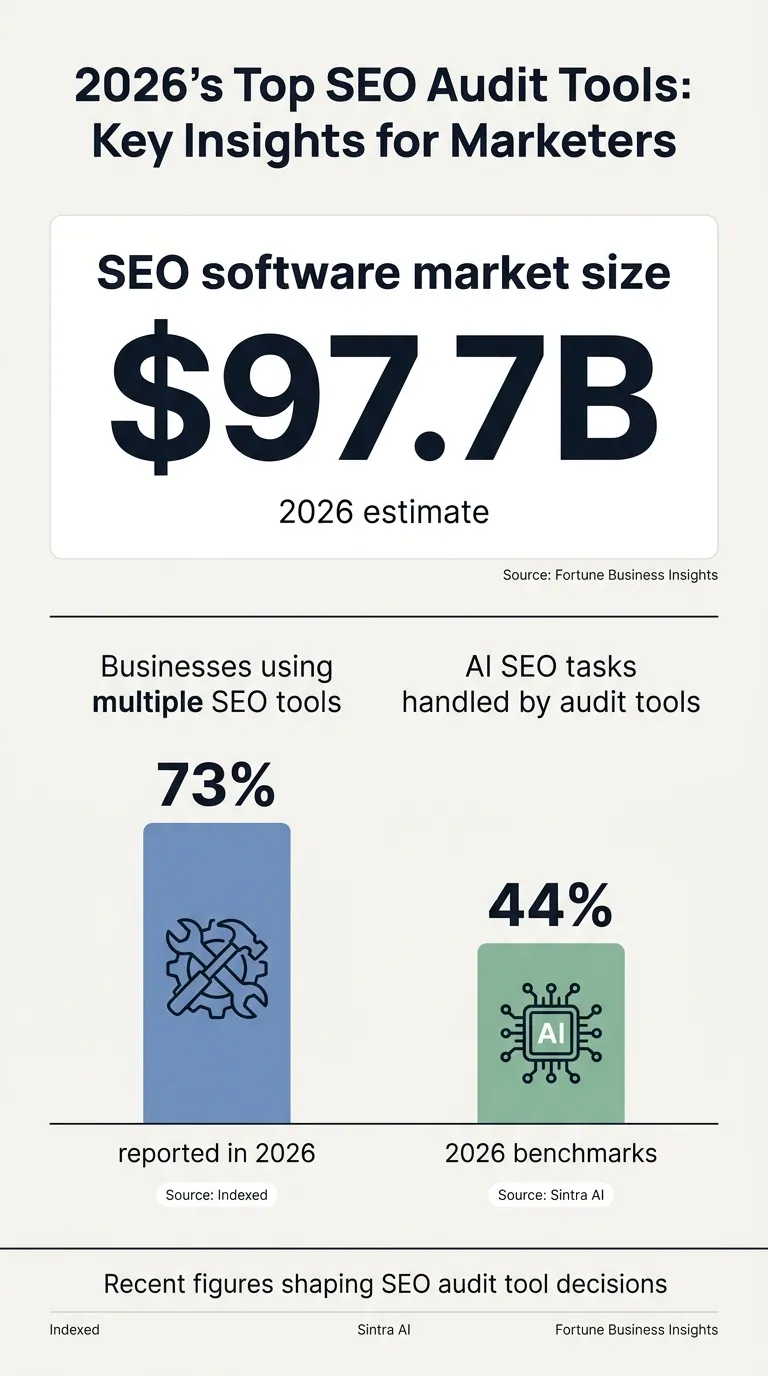
| Metric | Value | Period | Source |
|---|---|---|---|
| AI SEO tasks handled by audit tools | 44% | 2026 benchmarks | Sintra AI |
| Businesses using multiple SEO tools | 73% | reported in 2026 | Indexed |
| SEO software market size | $97.7B | 2026 estimate | Fortune Business Insights |
Those numbers help explain why generic audit reports are losing value. Marketers don’t need another huge spreadsheet full of warnings, since most teams will probably ignore a good part of it. They need ranked issues, evidence tied to each one, clear next steps, and some context on what matters right now. That’s where premium tools are starting to separate themselves from free options more clearly.
A common mistake is picking tools for the feature list instead of choosing a workflow that fits the actual job. That’s easy to do, honestly. If you’re running one site as a creator, Search Console, PageSpeed Insights, and a limited crawl setup may be more than enough. If you’re an agency with 40 client sites, though, you probably need automation, recurring reports, issue tagging, and stronger exports to keep the work manageable across clients. The right stack usually comes down to workload, not hype.
Ahrefs and Semrush are pulling ahead in different ways
The growing gap between premium platforms isn’t really about who has the longest feature list. What usually matters more is which one helps with the right problem faster. Ahrefs and Semrush both rank near the top for marketers, but they tend to stand out in different areas.
Ahrefs is often the better fit when the audit process depends on backlink data, content gap analysis, and quick competitive research. That’s usually where it helps most. If a team needs to show why a page is underperforming compared with a competing page, Ahrefs can make that easier. It also tends to work well for content refresh workflows because it brings ranking drops, link signals, and topic coverage into one view, which can save time.
Semrush usually makes more sense for teams looking for a broader system. It brings technical findings, visibility tracking, reporting, collaboration, and related workflow needs together in one place. That often makes it a good option for agencies and in-house teams that need executive summaries, task systems, and reporting across several projects. That’s often the main reason teams choose it.
Neither tool replaces a dedicated crawler for large technical jobs. That’s still true, so many teams pair one of them with Screaming Frog. When the main challenge is getting technical fixes shipped, the more technical lens in How to Run an Automated SEO Audit That Finds Issues may also be worth a look.
Choose Ahrefs when backlink depth and competitive insight are driving the work. Semrush usually fits better when reporting and all-in-one management matter more, especially across multiple teams. Using both only makes sense when the workload truly justifies the cost, since most teams probably won’t need both.
How marketers should build a leaner audit stack
The best stack is often smaller than people expect, honestly. Most teams don’t need every popular platform. What they usually need is coverage for four jobs: trusted data, technical crawling, prioritization, and reporting.
In most cases, a lean setup usually looks like this:
1. Start with first-party truth
Start with Google Search Console as your main reference for indexation and performance. Add PageSpeed Insights too, since it helps check page experience. It’s a good place to start.
2. Add one crawler or broad audit platform
For technical depth, Screaming Frog is still a solid pick, I think, and it’s fairly simple too. If a more guided workflow sounds better, Semrush or Ahrefs will probably feel easier for mixed teams, especially if they’re not very technical.
3. Match tools to your real bottleneck
If reporting is the problem, choose the platform with stronger exports and dashboards, since that’s usually the practical part. But if technical debt is slowing things down, the better pick is the one that shows crawl issues fastest. For AI-search readiness, visibility tracking beyond standard rankings often matters most.
4. Review overlap every quarter
Marketers often end up paying for duplicate features without noticing, and that’s pretty easy to miss. When two tools are sending over the same weekly insights, you usually only need one.
For brands looking at AI-driven workflow support, platforms like SEO Bot Software are part of a broader move to get technical SEO, automation, and content systems working together instead of keeping them in separate silos, which often helps.
Why AI visibility is changing what an audit should include
A big recent change is that an audit isn’t only about where pages show up in traditional blue-link search anymore. It also checks whether a site can be understood, cited, and shown across AI-led experiences, which is a pretty big change. That doesn’t mean classic SEO has disappeared. Not at all. It just means the checklist usually needs to cover more now, so there are a few more things to review than before.
A stronger audit now brings structured data, internal links, topical coverage, answer-ready formatting, and freshness signals together instead of treating them as separate items. That’s a big reason content work and technical work are starting to overlap. A page might be crawlable and indexed but still not show up well in AI-led results if the writing isn’t clear, the supporting entities are thin, or the source signals are weak. In many cases, that’s where pages get missed, even when the basics look fine.
Newer automation layers can help here by connecting technical findings with content changes instead of splitting teams across separate systems. That tends to make things easier. If the work covers both AI search visibility and classic SEO, the broader comparison in Best SEO Optimization Tools for AI Search Visibility gives helpful context and can save some back-and-forth.
When planning this out, a useful question to ask is whether the tool just spots issues or also helps the team fix them faster. That quick check often clears out a lot of noise, especially when it’s time to decide what to fix first.
Frequently Asked Questions
What are SEO audit tools used for?
SEO audit tools go through a website and flag technical, content, performance, and other issues that can hurt search visibility. With them, marketers can spot crawl errors, broken links, missing metadata, weak internal linking, slow pages, and other problems before rankings or traffic drop.
Are Google SEO tools enough for most marketers?
Google SEO tools matter, but by themselves they don’t always cover enough. Google Search Console and PageSpeed Insights give you a solid baseline you can trust. They don’t replace thorough crawling, competitor analysis, or advanced reporting. So most growing teams end up using them alongside at least one paid platform.
Which is better for audits: Ahrefs or Semrush?
It depends on the workflow. Ahrefs is better for backlink analysis, content gaps, and quick competitor research. Semrush is better for all-in-one reporting, project management, and broader team collaboration.
When should a team move from free tools to paid SEO audit tools?
It’s usually worth switching once your site starts growing, the reporting load gets heavier, or manual checks are eating up too much time. That’s simple enough.
If your team manages many pages, several clients, and recurring technical issues, paid automation can quickly pay for itself by saving hours. It’s a clear win.
How can AI help with SEO audits without replacing human judgment?
AI can sort the findings, catch patterns, and bring the most important fixes to the top more quickly. You still need people to review it. Teams also have to tie those findings back to business goals, content strategy, and the dev resources they actually have. So use tools to help with decisions, not to make every call for you.
Is there a good resource for comparing audit workflows and automation options?
Yes. If an SEO team needs practical side-by-side comparisons, SEO Bot Software is one review-based resource that looks at AI-powered audit workflows, technical SEO automation, and overall tool fit. It’s useful for comparing whole categories, not only individual products.
Put these insights into practice
The latest trend is pretty easy to see: the best SEO audit tools are becoming decision tools, not just scanners. Free Google SEO tools still matter because they give a baseline source of truth, and that’s still useful. At the same time, premium platforms are going further with better prioritization, stronger reporting, and a closer connection between technical issues, content work, and workflow action.
For marketers, this usually isn’t about finding one perfect platform. It’s more about building the right mix for how a team actually works. A good place to begin is with data the team already trusts, and to keep things simple at the start. Then bring in one paid layer where the team is losing the most time, usually in reporting or issue prioritization. It also helps to keep the stack lean, check for overlap on a regular basis, and pick tools based on the work the team is really handling each week rather than what just looks impressive.
If platforms are being compared right now, the main things to look at are crawl depth, how clear the recommendations are, the quality of the reporting, and whether the tool supports newer AI-led visibility needs. That matters when the market keeps moving, and it can move fast, because those points help teams stay grounded as they assess change.
SEO Bot Software regularly looks at how technical SEO audits, AI automation, and content operations are starting to merge into one workflow. That’s the next change marketers need to watch.