TLDR; An AI SEO content generator should help, not publish on its own. Use it for briefs, keyword clustering, outlines, refreshes, metadata, and first drafts. AI SEO content falls short when it lacks originality, firsthand experience, fact-checking, and brand voice.
Define search intent first. Have AI make the brief and draft, then add human expertise and strict quality checks before publishing. Focus on semantic coverage, useful structure, GEO, and governance, not more low-value pages.
AI tools now appear in almost every content workflow, so they’re pretty hard to ignore. An AI SEO content generator can help teams move faster and publish for a wider range of keywords without adding headcount, which is a big deal for small teams. For busy marketers, that’s an easy sell. Still, speed is only one part of what matters here.
The more useful question is when an AI SEO content generator actually improves results and when it just creates thin pages that struggle to rank in search. That matters for digital marketers, SEO pros, agencies, and creators who need content that performs in traditional search and in newer AI-driven discovery, and those two don’t always match in practice.
Put simply, AI usually works best as an assistant instead of a hands-off publisher. It can help with briefs, outlines, content updates, metadata, keyword clustering, and first drafts, and that can save a lot of time. Where it often falls short is original insight, lived experience, careful fact-checking, and a clear brand voice. In this guide, readers will find the best use cases, the real limits, common mistakes, and a practical workflow for using AI-generated SEO content without letting quality drop. It also connects the topic to modern SEO automation, WordPress publishing, and the broader shift toward AI search optimization and GEO, which probably matters more now than it used to.
Why AI SEO content generators became standard so fast
The adoption numbers are huge. Ahrefs reports that 87% of marketers use AI to help create content, and teams using it publish 42% more content, with a median of 17 articles a month versus 12 for teams that do not use AI (Ahrefs). That is a pretty clear gap. Another study from Ahrefs and Originality.ai found that 74.2% of newly created web pages contained AI-generated content in April 2025, based on 900,000 pages (Ahrefs).
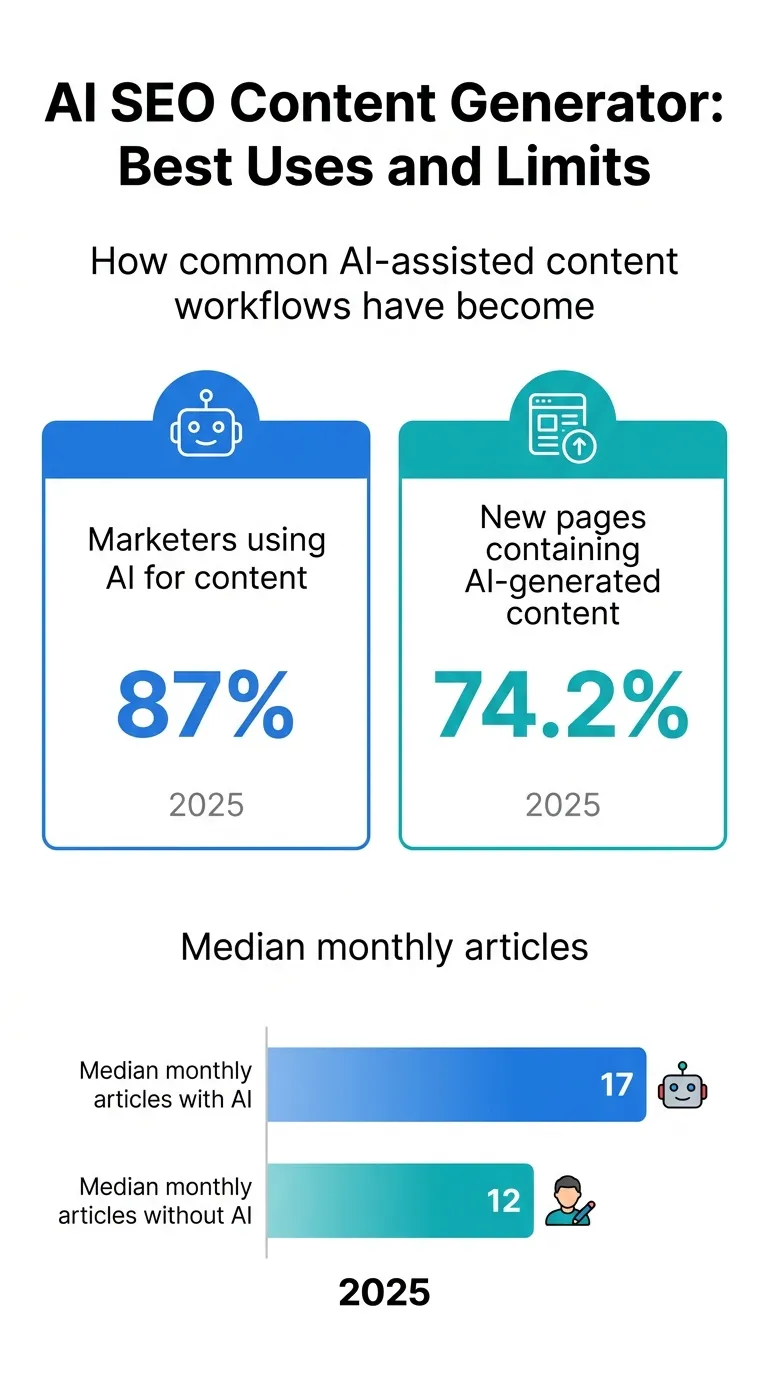
| Metric | Value | Year |
|---|---|---|
| Marketers using AI for content | 87% | 2025 |
| New pages containing AI-generated content | 74.2% | 2025 |
| Median monthly articles with AI | 17 | 2025 |
| Median monthly articles without AI | 12 | 2025 |
Those figures help explain why the SEO content generator market grew so quickly. Teams are under pressure to produce more landing pages, blog posts, product copy, updates, and FAQs, which is a lot to handle. In most cases, AI removes the slowest part of the job: staring at a blank page. It can also pull together related topics, entities, user questions, and rough draft structures much faster than one person working alone.
Still, smart teams usually do not publish right away. Ahrefs also found that 97% of companies review AI content before publishing. That helps explain the trend. The best setup is usually not full automation, but assisted production with human review. So if you want a practical baseline for how these tools fit into a broader workflow, that is covered here, and it is probably the most useful part: beginner guide to AI writing generators. Teams scaling production across departments may also want to review Enterprise SEO Automation for Large Content Teams for a broader look at operational workflows.
Focus on accuracy, quality, and relevance, especially when automatically generating the content.
Google Search Central Tweet
The best uses of an AI SEO content generator
The best use cases usually come up where speed, consistency, and structure matter more than deep original thinking. That often includes content ideas, keyword clustering, outlines, first drafts, content refreshes, product descriptions, category intros, metadata, and FAQ generation, which is where teams often save a lot of time. In most cases, it is less about replacing strategy and more about helping teams get through repetitive work faster.
For example, agencies often use an AI SEO content generator to create briefs from live SERP patterns. It can group related keywords, suggest headings, show common questions, and point out missing subtopics. That makes it a useful time-saver in this kind of workflow. It also helps teams update older pages that already rank but need fresher examples, newer stats, or more complete coverage, especially when those pages are already on page one.
Repurposing is another strong use case. A webinar transcript can become a blog post, a set of FAQs, social snippets, and email copy. Ecommerce teams also use AI-generated SEO content across large product catalogs, especially when they need unique supporting copy at scale instead of repeating supplier descriptions. That is probably one of the clearest practical benefits here, because writing thousands of product blurbs by hand usually is not realistic.
This is also where AI becomes more useful as part of a bigger SEO stack. Many tools now connect content work with internal linking, content scoring, and audit signals. So in practice, teams can move from a keyword idea to a draft and then through optimization in one workflow, which often helps things move smoothly. For teams comparing broader tool setups, AI SEO platform picks for content optimization covers that part of the process in more detail. Related comparisons in Content Marketing Tools for SEO-Led Teams can also help marketers evaluate how these workflows fit into day-to-day publishing.
Where AI-generated SEO content hits a wall
AI has real limits, and this is where a lot of teams get into trouble. A machine is very good at remixing language that already exists on the web, sometimes a little too good. What it usually cannot add by itself is firsthand experience, real testing, a clear point of view, or strong subject knowledge. As competition gets tighter, that gap often gets easier to see. That’s the real issue here.
Semrush found that purely AI-generated content reached the top spot only 9% of the time, while human-written content did so 80% of the time (Semrush). At the same time, 72% of SEO professionals who use AI content believe AI-assisted content performs as well as or better than human-written content. Both of those ideas can be true, and they probably are. AI-assisted content can perform well, but pure AI content is usually a much riskier choice.
The usual failure points are easy to spot once they start showing up:
- generic intros and repeated wording
- factual errors or claims that are simply made up
- weak brand voice
- shallow advice with no real examples
- over-optimized copy aimed at keywords instead of real readers
Google’s guidance is not anti-AI. It is clearly against low-value content. Search systems look for usefulness, originality, and trust. That usually matters even more in finance, health, legal, and technical topics, where accuracy is critical for obvious reasons. There is no room for sloppy claims.
The Lowest rating applies if all or almost all of the MC on the page … is copied, paraphrased, embedded, auto or AI generated … Such pages should be rated Lowest, even if the page assigns credit for the content to another source.
Google Search Quality Rater Guidelines, Search Engine Land Tweet
That does not mean every AI-written page will fail. But pages that bring nothing new are the ones at the biggest risk. Teams trying to improve tone and readability without stripping away optimization may find AI Content Humanizer Tips Without Losing SEO useful for refining AI-assisted drafts.
A practical workflow that keeps quality high
The safest way to use a SEO content generator is usually to split the work into stages. AI can handle the repetitive parts and keep them short and useful. People should still make the judgment calls, because that part often matters most.
A simple workflow looks like this:
1. Start with search intent
Before you create anything, define the page goal. Is the query informational, commercial, or transactional? AI can likely help sort out the intent, but in most cases a strategist should still sign off on it.
2. Build the brief with AI
Use AI for related topics, entities, People Also Ask-style questions, and rough heading ideas, which is really handy. This is usually where it helps you work faster, and you’ll probably notice that.
3. Generate a draft, not a final page
Ask for a draft with clear sections, simple wording, and any known gaps marked for review, since that part matters. It doesn’t need to be perfect, just useful, easy to follow, and clearly structured. And asking the tool to sound “perfect” often goes wrong.
4. Add human expertise
Add examples, firsthand observations, client lessons, screenshots, product details, or small nuances. I think that’s often what makes AI-generated SEO content feel useful enough to rank.
5. Run QA before publishing
Before you publish, it’s easy to miss small things, so facts, links, claims, brand voice, and duplication all need a quick QA check. On WordPress sites, that often means AI drafts with editorial review, plus plugin-based on-page checks, which is probably a common setup. If that is your stack, this guide to WordPress SEO plugins that fit AI content workflows is directly relevant for you. Teams focused on streamlining editorial systems may also benefit from SEO Workflow Automation for Lean Content Teams.
The main idea is simple: AI should cut production time while still keeping editorial standards in place.
New limits in the age of AI search and GEO
Search is changing fast. Content still needs to do well in classic rankings, but now it also has to show up in AI-driven discovery, like summaries, answer engines, and conversational search, which is a pretty big shift. Because of that, the old habit of forcing exact-match phrases into every heading is usually less useful than it used to be.
Modern AI SEO content generator workflows focus more on semantic coverage, clear structure, entity depth, and answer-first formatting. That often makes pages easier for search engines to understand, and for AI systems too. In practice, it is just more useful. It also supports GEO, where visibility can come from being cited in AI summaries or pulled into answers, not only from getting a blue link click.
Recent industry reporting shows that tools are doing more than drafting now. They also help with clustering, internal linking, AI visibility tracking, and SERP-driven recommendations (Darkroom). Put simply, the generator now feels like one part of a broader content system, not the entire thing.
The limits, though, have not really changed. If a page is bland, vague, or copied in spirit, better tooling probably still will not save it.
How agencies and lean teams should choose tools and rules
A good AI SEO content generator is more than a text box. It should fit how a team already works. That usually includes version control, prompt templates, editorial checkpoints, and clear rules for what AI can and can’t do, which often makes a real difference.
For agencies, governance matters just as much as the feature list. Style guides, reviewer roles, approval steps, and consistent client work help keep a project on track from brief to final draft. Lean teams usually need something simpler: fewer tabs, faster briefs, easier updates, and a practical way to keep quality steady across lots of pages. Less friction usually creates a better flow, and that often helps teams keep moving.
Research from Semrush found that 65% of businesses reported better SEO results thanks to AI, and 67% reported improved content quality (Semrush). Those gains usually show up when AI is part of a real process, not when teams publish rough drafts at scale without editing. That point often matters more than people think.
That is one reason platforms like SEO Bot Software stay relevant in this discussion. The benefit is not just faster writing. It also comes from seeing how content generation connects with audits, optimization, and newer AI search workflows, so it is not used on its own. SEO Bot Software also helps teams compare tools in a more useful way instead of treating every generator as basically the same. Teams comparing broader software categories may also want to review Essential SEO Writing Tools for 2026: Boost Your Content when evaluating long-term workflow needs.
Frequently Asked Questions
What is an AI SEO content generator?
An AI SEO content generator is a tool that helps plan, draft, and optimize content for search visibility. It usually supports tasks like outlines, keyword grouping, headings, FAQs, metadata, and early drafts.
Is AI-generated SEO content bad for rankings?
Not by itself. Google focuses on whether the content is helpful, accurate, relevant, and original enough to serve users well. The bigger risk comes from publishing low-value pages that feel copied, shallow, or unedited.
What are the best tasks to automate with a SEO content generator?
The best tasks are repetitive ones: brief creation, metadata, FAQ drafting, content refreshes, category text, and first drafts. These jobs benefit from speed and structure, while the final page still benefits from human editing.
Can AI-generated SEO content rank on page one?
Yes, it can. Semrush data suggests AI-assisted content can perform well, but purely AI-generated pages are less likely to win the top position than content shaped by humans. In short, AI helps most when people improve the draft.
How can I make AI content sound more human without losing SEO?
Add specific examples, real experience, brand language, and fact-checked details. Cut filler, replace vague claims, and simplify stiff phrases. SEO Bot Software covers this balance well in its tool reviews and workflow content, especially for teams trying to improve automation without sounding robotic.
How do I choose the right AI SEO content generator for my team?
Start with your workflow, not the hype. Look for support for briefs, SERP analysis, optimization, WordPress publishing, and review steps. A resource like SEO Bot Software can help teams compare tools through the lens of SEO automation, technical fit, and AI search readiness.
Put AI to work without handing over the keys
The useful takeaway isn’t “use AI for everything” or “avoid AI completely.” It’s more practical: use AI where speed and structure help most, like outlining, grouping topics, or getting a solid first draft done quickly. But people still need to stay responsible for accuracy, insight, tone, and final quality, because that’s usually the part that matters most.
So an AI SEO content generator can be helpful for ideas, topic clusters, briefs, updates, and early drafts. At the same time, teams should be more careful with AI-generated SEO content on topics that need real expertise or involve trust risk, especially in health, finance, or legal areas. It’s also worth remembering that rankings usually come from usefulness, not just volume, and that’s often easy to overlook.
If a team wants stronger output, a simple system helps. Start by defining intent. Then generate. Edit hard. Check facts. Improve the voice before publishing and tracking performance. In most cases, that kind of process is much more likely to produce content that ranks, builds trust, and keeps working as search keeps shifting toward AI-driven discovery.
Used this way, AI can be a strong teammate: definitely helpful. But used carelessly, it can quickly fill a site with average pages, and that may not be obvious right away. The process is usually what makes the real difference.