TLDR; Busy watching AI Mode take over search? Here’s the short version.
Google is making AI answers the default, so SEO now means two jobs: rank and get cited. AI citations have limited overlap with top organic results, zero-click searches are rising, and traffic may fall. Track AI mentions, branded lift, referral quality, and citation frequency. GEO wins with clear headings, factual answers, strong entity signals, and fresh evidence. Traditional SEO still matters: a website SEO checker remains useful for crawl issues, speed, schema, and site structure.
Google’s latest shift isn’t a test anymore, and it isn’t some side feature either. AI Mode is moving into the center of Search, and for marketers using a website SEO checker, that changes the rules right now.
At Google I/O this year, the company made it pretty clear: generated answers are becoming the main interface people see first. For SEO teams, content creators, and agencies, the old race for blue-link rankings is no longer enough. Not even close. A page can still rank well and still lose the click if AI answers solve the query before a user ever reaches the site.
Search is becoming less about position and more about being chosen. In 2026, the job isn’t just to rank pages. It’s also to make content easy for AI systems to trust, pull from, and cite. Simple idea, big shift. In plain terms, classic SEO still matters, but geo optimization now sits right beside it.
This article covers what changed, what the latest numbers show, how teams can adjust their workflow, where a website SEO checker still helps, and what teams should do next if they want visibility in search results and AI answers.
Why AI Mode Changes the SEO Game
The biggest shift is simple: search now starts with an answer, not a list. According to Ring Publishing, Google has moved AI Mode from an experiment into default search behavior, so the generated response now appears in the middle of the page instead of acting as a supporting feature (Ring Publishing). That changes how people find content in a very direct way.
For years, SEO was about landing in the top results and winning the click. In AI Mode, something else matters more: whether a page becomes one of the sources behind the answer. Ring Publishing found that only 53.68% of domains cited in AI Mode overlap with Google’s organic top 10, and at the page level, that overlap falls to 35.41% (Ring Publishing). Rankings still matter, but they no longer tell the full story.
That also explains why geo optimization is getting more attention. Generative engines may care less about raw keyword matching and give more weight to clear facts, topical depth, entity consistency, and trust signals across the web. A specialist article with a clean structure can now earn AI visibility even if it isn’t the strongest page in the classic SERP.
A lot of teams need a mindset reset. SEO is no longer just a traffic channel. It’s becoming a visibility layer that includes clicks, citations, mentions, and brand recall. That broader role changes what success looks like.
The New Metrics That Matter in 2026
If AI Mode becomes the default, reporting needs to change. Traffic still matters, but on its own it can hide what’s really going on, because a page might lose clicks while still gaining brand visibility inside AI summaries. Teams need to track classic SEO and AI visibility together.
According to the research cited in SEO Bot Software’s knowledge base, around 60% of searches are already zero-click, and traditional organic traffic is expected to drop by about 25% by 2026. At the same time, AI-referred traffic has been rising quickly, and those visitors can show stronger intent than regular organic visitors. So fewer visits do not always mean less value.
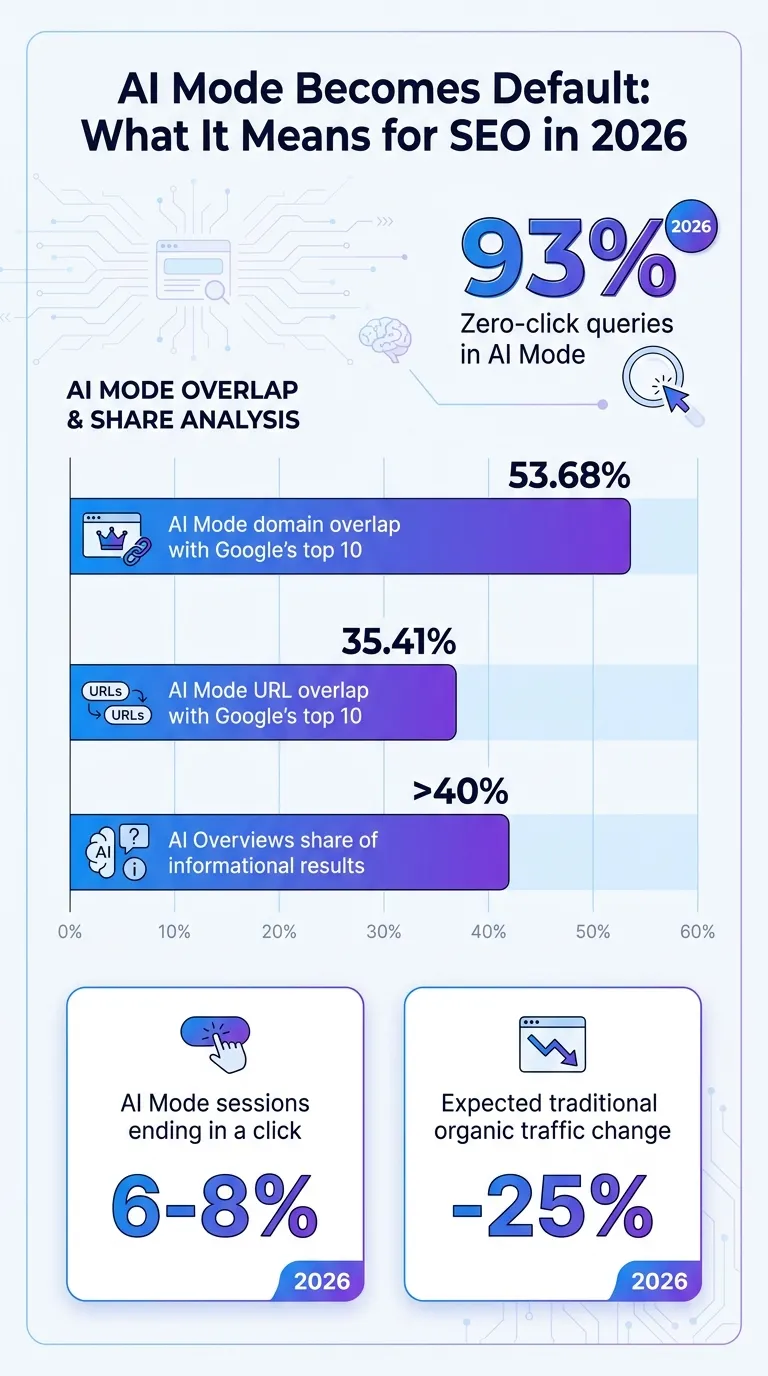
<DataTable
headers={[“Metric”, “Value”, “Year”]}
rows={[[“AI Mode domain overlap with Google’s top 10”,“53.68%”,“2026”],[“AI Mode URL overlap with Google’s top 10”,“35.41%”,“2026”],[“AI Overviews share of informational results”,“>40%”,“2026”],[“AI Mode sessions ending in a click”,“6-8%”,“2026”],[“Zero-click queries in AI Mode”,“93%”,“2026”],[“Expected traditional organic traffic change”,“-25%”,“2026”]]}
caption=“Key search behavior shifts shaping SEO in 2026”
source=“Ring Publishing”
sourceUrl=“https://ringpublishing.com/blog/ai-tools-and-insights/google-io-2026-ai-mode-ai-overviews-and-the-end-of-classic-seo/sy6pc4b”
/>
Old dashboards no longer show enough. Smart teams are tracking:
- AI citation frequency
- Branded search lift
- Referral traffic from AI tools
- Topic coverage by entity, not just keyword
- Conversion quality from lower-volume sessions
A solid website SEO checker guide still helps here, though its role is changing. It should help teams spot crawl issues, weak headings, missing schema, slow pages, and thin sections that make content harder for AI systems to understand. It’s useful, but not the whole strategy. It acts as the diagnostic layer behind it.
Teams comparing broader workflows can also review Website Optimization Tools for SEO and Conversions when deciding how technical audits fit into AI search visibility.
What Geo Optimization Looks Like in Practice
Geo optimization is sometimes mistaken for a fancy new name for SEO, but it’s different. Traditional SEO tries to rank the page. GEO focuses on making the knowledge on that page easy for AI systems to retrieve, summarize, and reuse.
In practice, that means a few clear changes.
Start with clean blocks. AI tools do better with pages that answer one question at a time, use direct subheads, and skip fluffy intros. Keep claims specific too. Vague copy is hard to cite. Clear statements, useful examples, and updated facts are much easier for AI systems to pull into answers. Entity signals need to be stronger too. Your brand, services, authors, and topic areas should line up across your site and other trusted mentions online.
Still, content teams can push this too far. Pages built like robot checklists can feel rough to read, and they do badly with people too. That’s the catch. Aim for structured clarity, not sterile writing. Getting that balance right shapes how the page works for readers and for AI systems.
According to Ring Publishing, AI Overviews now appear in more than 40% of informational results, while only **6% to 8% of AI Mode sessions end with a click to an external site (Ring Publishing). So content has to deliver value before the click, not only after it.
If your team is building new workflows, AI SEO tools for GEO tracking and AI visibility become useful here. They help teams track where brands show up in AI-generated answers and which topics lead to those mentions.
Teams looking for more detailed implementation ideas can also review Generative Engine Optimization Guide for 2026 to compare GEO workflows and visibility tactics.
Where Traditional SEO and a Website SEO Checker Still Matter Most
AI Mode doesn’t replace SEO. It widens what SEO needs to cover. Strong organic rankings still matter for discovery, authority, and citation chances, and plenty of AI systems still depend a lot on pages that already show clear relevance and trust in search.
So yes, the basics still count:
- Fast page speed
- Clean crawl paths
- Strong internal linking
- Helpful headings
- Updated content
- Clear authorship and source support
What changes is why the work matters. Before, teams fixed technical issues mostly to improve rankings. Now they also do it so machines can read and understand content correctly. A broken canonical, weak page structure, or a slow mobile load can hurt search visibility and also reduce AI citation potential.
A website SEO checker still belongs in the stack in 2026. It helps teams spot the friction that makes pages less useful for people and AI systems. Teams that combine technical cleanup with better answer formatting will likely have an edge.
For WordPress teams especially, platforms like SEO Bot Software fit this moment because the workflow is no longer just about publishing more content. The job is wider now. WordPress teams need to audit, improve structure, and adapt pages for mixed visibility across search and generative engines.
Additionally, technical teams focused on performance can learn from Page Speed Optimization for AI Search Visibility because loading speed and rendering quality now affect both rankings and AI citations.
How Agencies and Content Teams Should Respond Now
Stay calm and make a priority map instead of trying to redo everything at once.
Start with the pages that already rank or convert well. Those are often the best choices for geo optimization, because search engines and users already trust them to some extent. Add clearer subheads. Short answer blocks can help, along with factual summaries and stronger supporting evidence.
Then update measurement. Teams should add AI mentions, assisted conversions, and branded lift to regular reporting so they can track more than top-level traffic. If a team only watches sessions, it may miss real gains.
Then split content by role. Some pages should aim for direct clicks, like product, service, and comparison pages. Others should focus more on citation value, including glossaries, explainers, FAQs, and category education pages.
Also tighten the publishing process. Every new page should pass a quick checklist: Is the page easy to scan? Does it answer the query fast? Are claims precise? Is the page technically sound? An SEO optimization software guide can help teams compare how tools support audits, reporting, and automation.
One more practical point: earned mentions matter more now. SEO Bot Software notes in the knowledge base that third-party mentions can strongly improve a brand’s chances of showing up in AI answers. That makes digital PR, partnerships, and expert contributions part of the visibility strategy, not side tasks.
Agencies exploring automation-heavy publishing models may also want to compare SEO Automation Software for Lean Marketing Teams with their current reporting and optimization workflow.
What to Audit First When AI Mode Becomes Default
If you need a place to start this week, check these five areas first.
Content clarity: Make the main answer easy for readers and machines to find quickly.
Structure: Use headings that match real questions and follow clear, logical subtopics.
Evidence: Keep examples, numbers, and claims specific, and keep them up to date.
Technical health: Make sure search engines can crawl, render, and index your key pages without issues.
Entity consistency: Show the same focus and expertise across your site and in external mentions.
Geo optimization gets practical here. Don’t chase every AI trend. Make your best information easier to pull out, easier to trust, and more consistent across places.
When your team needs a broader view of where this is going, a resource like an AI-powered SEO automation reviews platform can help compare tools for technical audits, AI content workflows, and generative search visibility without turning your stack into a mess.
Frequently Asked Questions
Is AI Mode replacing traditional SEO?
No. Traditional SEO still matters because strong rankings, crawlability, and page quality continue to support visibility. What changes is that SEO now works alongside geo optimization, where being cited in AI answers can matter as much as winning a click.
What is geo optimization in simple terms?
Geo optimization means shaping content so AI systems can understand, trust, and reuse it in generated answers. It focuses on clear structure, factual writing, topical consistency, and signals that help your brand get cited.
Do I still need a website SEO checker in 2026?
Yes. A website SEO checker still helps you find technical issues, weak structure, missing metadata, slow pages, and crawl problems. Those issues hurt both classic search performance and your chances of being selected in AI-driven results.
What content is most likely to win citations in AI Mode?
Pages with direct answers, strong structure, updated facts, and clear topical focus tend to do better. Explainers, FAQ pages, glossaries, category guides, and expert-led analysis often have strong citation potential.
How can agencies track AI visibility without overcomplicating reporting?
Start with a small set of new metrics: AI mentions, branded search lift, assisted conversions, and referral traffic from AI tools. SEO Bot Software and similar platforms in this space are useful examples because they help teams combine audits, AI visibility checks, and workflow automation in one place.
What should I update first on an existing site?
Begin with pages that already rank, convert, or support high-value topics. Improve headings, tighten answers, refresh facts, and fix technical issues first. That gives you the best return without rebuilding the entire site.
Put This Shift Into Practice With a Website SEO Checker
The main takeaway from AI Mode becoming the default is simple: SEO isn’t dead. Lazy SEO is. In 2026, brands need to do two things at once. They have to help search engines rank their pages and help AI systems trust their information enough to cite it.
It’s a big shift, but it’s workable. Keep the technical foundation strong. Use a website SEO checker to catch issues that hurt performance before they turn into bigger problems. Build content around clear answers instead of relying only on keywords. Treat geo optimization as part of content design instead of leaving it as an afterthought. Expand reporting as well, so teams can track citations, mentions and conversion quality alongside clicks.
Teams that act now will be in a better position than teams that wait for traffic to drop and respond later. If AI Mode is becoming the default interface, the question has changed. Not “How do I rank number one?” Now it’s “How do I become the source AI chooses first?” That’s the SEO question that matters most now.