TLDR; Need the AI-search version fast? SEO still comes first: AI Overviews and answer engines cite pages that already rank well.
What changes is format. Make high-value pages easy to extract and trust: clear passage-level answers, stronger headings, solid structure, proof, and consistent entity mentions across the web. Track more than clicks as AI answers grow: citations, mentions, branded search lift, assisted conversions, and AI referral traffic. Start with high-value pages first, add concise answer blocks, and keep human review on accuracy and brand voice.
Search is no longer just a list of links. People often get answers from AI Overviews, chat tools, answer engines, and other quick results before they click through to a website, and that probably sounds familiar. That shift has led a lot of marketers to ask a pretty simple question about ai search optimization: if classic SEO still matters, what actually changes with AI search optimization?
The short answer is still simple: SEO remains the foundation, and generative SEO adds another layer on top. It’s not just about helping a page rank anymore. It’s also about making that page easy for AI systems to read, trust, quote, and cite. In practice, that usually means clear writing, solid structure, useful facts, and a brand presence that feels consistent across your site, your social profiles, and other pages around the web. In most cases, that’s where the real difference shows up.
For digital marketers, SEO teams, content creators, and agencies, this changes both strategy and reporting. Visibility can go up while traffic drops, and that’s understandably frustrating. Rankings still matter, though. They’re just no longer the only sign of success. In this guide, you’ll see what stays the same, what changes, how generative SEO works in practice, and what your team should probably do next to stay competitive in classic search and AI-driven discovery.
Why SEO Still Matters in an AI Search Optimization World
A lot of headlines make it sound like AI search replaced SEO overnight. It didn’t. The strongest research still shows that classic rankings have a major effect on AI visibility. In seoClarity’s 2025 study, more than 99% of AI Overview results cited at least one page already ranking in Google’s top 10, and 97% cited at least one page from the top 20 (seoClarity).
That matters because it suggests AI search optimization usually is not a completely separate game with brand-new rules. In most cases, it builds on strong SEO basics. When a site is slow, thin, poorly linked, or hard to crawl, AI systems are less likely to surface that content too. Technical health still matters a lot here. Authority and relevance matter too, and they often carry a big part of the weight.
At the same time, AI answer surfaces are clearly growing. Semrush found AI Overviews on 6.49% of tracked queries in January 2025, then 24.61% in July 2025 in a later study, though the exact share probably changes depending on the dataset (Semrush). The practical takeaway is pretty simple: keep doing SEO, while also making room for AI visibility, because most sites will probably need both.
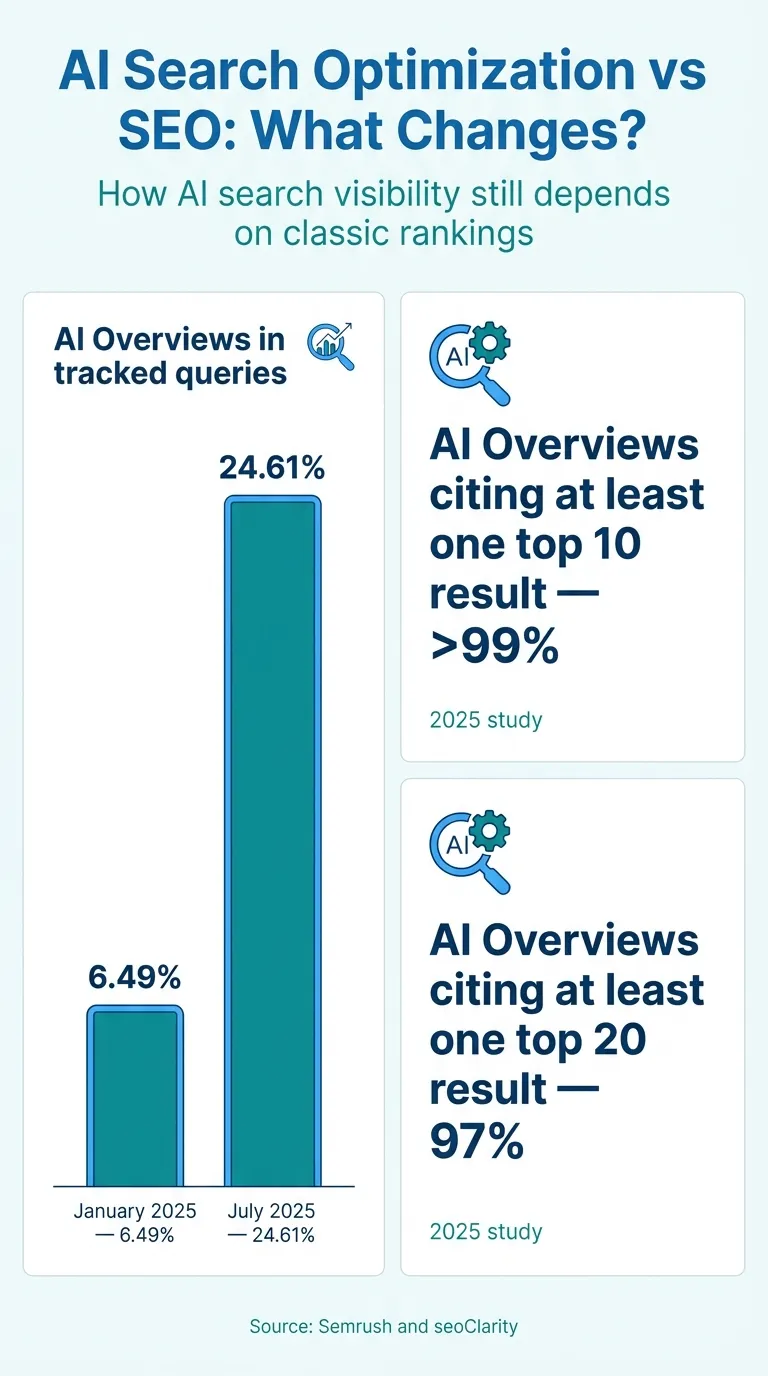
| Metric | Statistic | Period |
|---|---|---|
| AI Overviews in tracked queries | 6.49% | January 2025 |
| AI Overviews in tracked queries | 24.61% | July 2025 |
| AI Overviews citing at least one top 10 result | >99% | 2025 study |
| AI Overviews citing at least one top 20 result | 97% | 2025 study |
Still, those numbers do not mean every keyword works the same way. What they do show is that a strong SEO foundation usually gives a site its best chance to be seen and cited.
What Generative SEO Adds on Top of Traditional SEO
Traditional SEO asks, “Can this page rank?” Generative SEO asks, “Can this page be used inside an answer?”
That second question changes how content gets built, and it’s honestly a fairly big shift. AI systems often pull short passages, definitions, steps, and clear explanations, smaller pieces they can use directly. So when a page is buried in fluff or has weak structure, it may appear less often in AI answers than a page saying the same thing in a clearer way.
Here’s what generative SEO usually adds in most cases:
Passage-level clarity for ai search optimization
Each section should clearly answer one idea. Keep it simple, because that often helps. AI tools often don’t need the whole article; sometimes they just use one paragraph.
Better extractability
Content is often easier to sum up with direct definitions, short subheads, bullet points, and simple comparisons; they’re small things, really.
Better trust signals
Accurate facts and fresh examples often help. Author context and cited data usually make content feel more reliable to you.
Entity consistency
Your brand, products, services, and topic areas should be described the same way across your site and in other places people or search tools may check, like directory listings or social profiles. That kind of consistency likely helps keep things clear and easier to confirm.
If you want a closer look at how SEO bots support that process, we covered it in this guide on generative engine optimization with SEO bots. You can also compare broader workflows in this Generative Engine Optimization Guide for 2026.
Generative SEO is not really about stuffing more keywords into a page. It is more about making your best ideas easy to find, confirm, and reuse, which is usually what matters most in practice.
The Biggest KPI Shift: Visibility Can Rise While Clicks Fall
This is where a lot of teams get confused, and it’s easy to see why. In traditional SEO, more visibility usually meant more traffic. In AI search, that connection is no longer nearly as strong.
Now a page can be highly visible because it gets pulled into an AI answer, while the user still never clicks through. That does not mean the page failed. It means the search journey works differently now, and probably more than many teams expected.
Some research suggests that this click pressure is real. A 2025 analysis summarized on LinkedIn said organic click-through rate dropped by 61% when AI Overviews appeared. It also reported that searches ending in an organic click were 40.3% in March 2025, while the zero-click rate reached 27.2% (LinkedIn). Since that source is secondary, it makes sense to be careful about the exact size of the decline. Even so, the overall direction is hard to ignore.
That shift creates a new reporting problem for both agencies and in-house teams. If reporting only covers rankings and sessions, growing brand visibility inside AI answers and across answer engines can be missed. Better reporting now often includes:
- citation share in AI answers
- mention frequency across answer engines
- branded search lift
- assisted conversions
- referral traffic from AI tools
- page-level engagement after AI-driven visits
This also helps explain why measurement still feels messy. Search Console does not provide a clean AI Overview filter, so teams often rely on outside monitoring tools along with manual testing, which is not ideal. If a workflow needs stronger visibility tracking, tools and reviews on SEO Bot Software can help compare AI-driven SEO platforms and show differences in tracking, monitoring, and reporting without turning the article into a sales pitch. Teams looking deeper into reporting setups can also review structured data for AI search to understand how schema may support citations.
The biggest mistake is judging success only by clicks. In AI search, influence often shows up before the visit. In many cases, that happens when a brand, page, or site is cited directly in the answer, even if the click does not come right away.
How to Optimize Content for AI Search Optimization Without Rewriting Everything
The good news? You don’t need to rebuild a whole site from scratch, which is honestly a relief. Most teams can usually start with their highest-value pages and focus on structure first.
A practical workflow often starts there, since that’s probably the simplest way.
1. Pick pages that already rank or convert
Classic rankings still drive AI citations, so skipping random low-traffic content is usually a better call, since it often won’t help much. A smarter move is to start with pages already close to page one, pages with strong links, or pages directly tied to leads and sales. Simple.
2. Add answer blocks near the top
Give each page a direct definition or short answer near the top, since that usually helps. AI systems can likely understand the page faster that way. Keep it short, clear, and simple.
3. Break long sections into clean chunks
Use clear H2s and H3s, they really help. Keep paragraphs focused so they do not ramble. Add bullet points when useful, which is often. Short, helpful, and easy to scan.
4. Strengthen proof
Add facts, examples, and dates to time-sensitive claims, since that usually helps, along with clear explanations. Be specific, because AI systems often trust detailed content more than vague wording.
5. Refresh old pages on a schedule
A lot of AI visibility work really comes down to upkeep. Refresh core pages every few months so they stay current, useful, and worth reading, not just technically updated. In most cases, that helps keep the key information accurate.
One more thing: don’t confuse answer-ready with robotic. The content still needs a human voice. It should be clear but natural, and helpful but specific.
What Agencies and Content Teams Should Change in Their AI Search Optimization Workflow
For agencies, the service model is changing. Clients still care about rankings, of course, but now they also want clear proof that their brand shows up in AI-driven search journeys, not just in Google results. So the work starts to include new deliverables: AI visibility audits, citation tracking, content restructuring, and reporting that explains where that visibility is really coming from.
For content teams, briefs need to change too. A strong brief for generative SEO should usually cover:
- the main question to answer first
- the facts that must be included
- related entities and terms, plus useful context
- internal pages that support topic depth
- sections that can stand alone as quotable passages
This is also where automation becomes really useful. Bots and AI tools can review structure, catch thin sections, suggest internal links, and flag content gaps, which is honestly very helpful in day-to-day work. Still, people should handle judgment, accuracy, and brand voice. In most cases, a hybrid setup often works best.
Reviewing workflow tools right now? This article on SEO optimization software and analytics tools can help compare what matters beyond basic rank tracking, including citation tracking, structure checks, and visibility reporting. Agencies evaluating providers may also find this guide on how to choose an SEO agency in the AI search era useful when comparing capabilities.
The better move is not publishing more AI content. It is publishing content with stronger structure, the kind people trust and machines can actually use and often quote more reliably.
Frequently Asked Questions
Is ai search optimization the same as SEO?
No. AI search optimization builds on SEO but does not replace it. SEO helps your page get found and ranked, while ai search optimization helps that same page get cited, summarized, and reused in AI-generated answers.
What is generative SEO in simple terms?
Generative SEO means shaping content so AI systems can understand it easily and pull useful parts into answers. It focuses on clear structure, factual accuracy, trust signals, and passages that are easy to quote.
Do rankings still matter for AI search visibility?
Yes, very much. Current research suggests AI Overviews often cite pages that already rank well in organic search, so strong SEO remains the foundation for generative SEO.
How do I measure success if clicks drop?
Look beyond sessions alone. Track citations, AI referral traffic, branded searches, assisted conversions, and whether key pages show up in AI answer surfaces for your target topics.
Can SEO Bot Software help with generative SEO research?
Yes. SEO Bot Software is useful for marketers who want reviews and insights on AI-powered SEO automation tools, especially around technical audits, AI content workflows, and GEO strategy comparisons. It is most helpful when you are deciding how to build a practical workflow, not just chasing one feature.
Do I need new tools for ai search optimization?
Not always, but many teams do need better monitoring. SEO Bot Software can be a practical starting point if you want to compare platforms that support AI visibility tracking, content improvement, and technical SEO checks in one research process.
Put This Into Practice
The biggest change in the move from SEO to ai search optimization is not that the old rules disappeared; they probably haven’t. What has changed is that success now usually happens on two levels. First, content still needs to rank in search results and build trust, much like strong SEO always has. Second, it needs to be clear and well organized enough for AI systems to cite, summarize, or recommend. Two levels.
That is why generative SEO matters. The goal is no longer just about winning a blue link on the results page, but also about becoming part of the answer people actually see. For marketers and agencies, that means expanding content standards and workflows and, I think, rethinking reporting a bit too. Track mentions, not just clicks. You will often find it helps to build pages that answer quickly, usually near the top. Tighten the structure. Keep it short and clear. Refresh valuable content often, and keep humans involved in the review loop.
When that happens, there is no need to choose one side. SEO can still matter, and AI search optimization does too. So the system can support both: content strong enough to rank in classic search, while also clear enough to hold up in AI search. In my view, that balance often helps brands appear in search and stay useful when AI tools summarize their content.