TLDR; The article says video SEO matters now because people find content through YouTube, Google video results, and AI Overviews more often than through traditional blue links. That shift is real, and it changes how content gets discovered.
It also shows how AI for SEO can speed up keyword clustering, intent mapping, title and description writing, transcript cleanup, chapter creation, and performance analysis. AI content creation can also turn one video into several search assets, which saves time.
The guide makes clear that success comes from combining AI speed with human oversight, strong intent matching, rich video landing pages, transcripts, schema, and optimization based on engagement. Automation alone is not enough.
It also recommends building topic clusters around real search questions, publishing videos on pages with strong context, tracking retention and search metrics, and using AI to scale a connected video content system instead of relying on isolated uploads. That builds a system instead of posting videos one by one.
Video has moved far beyond a support format. For many brands, it now plays a main role in search. People look for answers on YouTube, Google is showing video results in more places, and AI Overviews are already changing how users find content. Because of that, video SEO and AI for SEO are no longer something marketers, creators, agencies, or in-house teams can brush aside.
What usually slows teams down is volume. Writing titles, testing thumbnails, figuring out search intent, building transcripts, adding schema, and repurposing clips all take more time than most teams want to give. AI for SEO helps reduce that workload. Good AI workflows can help teams move faster, spot patterns earlier, and improve content without leaning so much on guesswork. They also make AI content creation more useful by turning one video into several assets made for search.
This guide covers how AI can support YouTube video optimization, improve the chances of showing up in Google search and AI Overviews, and help build a stronger content system. It looks at video keyword research, metadata, transcripts, engagement signals, content repurposing, common mistakes, and practical tools. It’s a good starting point if a team wants search visibility that goes beyond standard blog posts.
Why video SEO and AI for SEO matter more in an AI search world
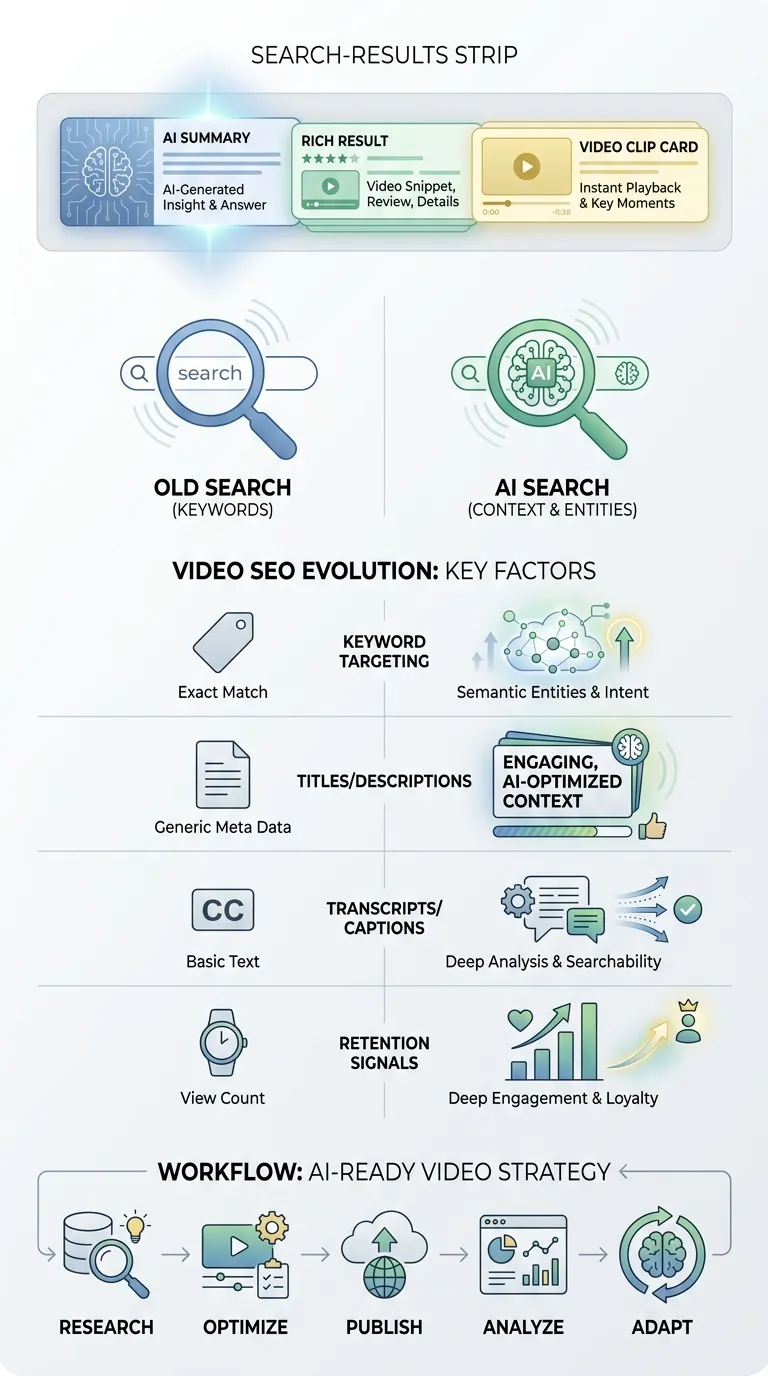
Search behavior is changing fast. People often see AI summaries, rich results, and video clips before they ever get to a standard blue link. That puts video in a better spot and makes it easier to get noticed early. It can grab attention right away. YouTube is also still one of the biggest search engines in the world, which gives brands two main search places to improve for.
For marketers, video SEO is no longer just about rankings. It also means matching intent, getting clicks, and keeping attention long enough to hold interest. That wider role matters more now.
| Video SEO area | Why it matters | How AI helps |
|---|---|---|
| Keyword targeting | Matches search intent on YouTube and Google | Clusters topics and suggests related terms |
| Titles and descriptions | Improves click-through and relevance | Generates variants and tests hooks |
| Transcripts and captions | Adds crawlable text and accessibility | Creates and cleans transcripts fast |
| Retention signals | Supports watch time and engagement | Finds weak points in scripts and structure |
The table makes the pattern pretty clear. AI doesn’t replace strategy. It removes busywork, so teams have more time for better content choices. That is especially helpful for agencies and lean content teams managing a lot of channels, and the difference usually shows up quickly in daily work.
How to use AI for SEO in YouTube keyword research and content planning
Good video SEO starts before recording, and that’s the part many people miss. AI makes it much quicker to map topics, search intent, and content gaps than doing it all by hand in a spreadsheet. Start with one core topic, such as technical SEO audits, ecommerce SEO automation, or Generative Engine Optimization. From there, an AI workflow can turn that into related searches, beginner questions, comparison angles, and problem-based queries.
That planning makes it easier to build videos for every stage of the funnel and see how the full set fits together. A top-of-funnel video may answer a broad question in a short, useful way. A middle-of-funnel video can compare tools or look at different methods. A bottom-of-funnel video can walk through a specific task. Clear relevance often performs well on both YouTube and Google.
A simple workflow looks like this:
1. Build topic clusters
Use AI to group keywords into clear themes instead of random phrases, which keeps things neat. For example, ‘AI for SEO’ can branch into audits, content briefs, schema, video improvement, or GEO, which is really handy.
2. Match each theme to a video format
How-to videos, product comparisons, short explainers, and case studies each fit a different kind of intent. AI can suggest the most likely formats based on how people search, so there’s less guessing.
3. Pull supporting questions
Tools can pull common follow-up questions from search results, comments, forums, and similar places, which is really handy. They’re useful for shaping chapters, Shorts, and FAQ sections.
For a better system around quality control for AI content, it’s covered here: AI Content Creation QA for Search Teams. It also works well for video workflows, since the same quality issues often show up in scripts, descriptions, and repurposed content.
Additionally, teams exploring content automation can look at Beginner’s Guide to AI Writing Generators for Content Creators for an introduction to practical automation workflows.
Improving titles, descriptions, transcripts, and chapters with AI for SEO
Once the topic is clear, AI starts working like a production assistant. It can suggest title ideas, improve video descriptions, turn rough notes into scripts, and create transcripts that support accessibility and search visibility. That makes AI content creation one of the most practical ways to save time. Repetitive work gets easier, while the human editor still stays in control.
A strong AI-assisted title should do a few things well: show the topic, make the benefit clear, and create curiosity without sounding spammy. Descriptions work in a similar way. Put the main topic near the beginning, add related phrases naturally, and give viewers a clear reason to keep watching. Chapters help too, especially in longer videos. They make the content easier to scan and give search engines more context.
For SEO, that can help because better engagement may support better performance over time.
AI tends to save the most time here:
Script cleanup
AI can cut weak intros, trim fluff, and make spoken language clearer, which really helps.
Transcript polishing
Auto-transcripts can miss brand names and technical terms. But AI corrects them fast, which honestly helps.
Description expansion
Turn one short summary into a clear 200 to 300-word description. Add keywords, timestamps, and linked resources so nothing is missed. Keep it useful and easy to read.
Chapter suggestions
AI can find natural breaks in your content and label them in simple, clear language, which is really handy.
If your team’s also looking at search features beyond traditional results, How to Optimize Content for ChatGPT, Perplexity, and Google AI Overviews gives a useful way to structure content so machines can understand it and cite it.
Moreover, Latest Trends in AI Content Creation: What’s Shaping 2026 explores how evolving AI tools are shaping modern SEO workflows.
Making videos more likely to appear in Google and AI Overviews with AI for SEO
Ranking on YouTube helps, but plenty of marketers want more, which is fair. They want their videos to appear in Google search too, and they want a better chance of showing up in AI-powered results. Technical SEO and content structure both matter here.
Start by publishing the video on a page that adds real context. Embedding the video by itself is not enough. A unique summary, main points, transcript sections, and clear headings give the page more useful text and clearer signals for Google to understand what it covers and how it should rank.
It also helps to think in entities and topics instead of only exact keywords. AI Overviews pull useful information from multiple sources, so a video page that clearly covers a topic, answers direct questions, and shows expertise has a better chance of being used.
Common mistakes to avoid include:
Thin embed pages
A video and only a couple lines of text on a page really don’t give search systems much to go on. That’s it.
Mismatched intent
A flashy title may promise one thing, but if the video shows something else, trust drops fast. It can hurt retention, too.
Ignoring schema and transcripts
These basic signals make content easier to read and parse. Pretty simple, really.
If you want to look closer at markup and machine-readable context, Structured Data for AI Search: Schema Tactics That Help Bots Cite Your Content is a good next read if you’re curious.
Measuring what AI for SEO should improve next
Many teams still start by watching views. For video SEO, that number only tells part of the story. Metrics like click-through rate, average view duration, retention by segment, subscriber lift, assisted conversions, and page-level search traffic for embedded videos usually give a clearer picture than raw views on their own.
AI is useful here because it can catch patterns that are easy to miss. It can compare high-retention videos with low-retention ones, point out the exact moments where viewers drop off, and connect script structure to real results. It can also sort comments into themes, which makes it easier to spot fresh content ideas and repeated problem areas while planning the next batch.
Search Engine Journal points to a broader shift away from page-level SEO and toward topical authority plus better audience understanding in AI-driven search (Search Engine Journal). For video teams, that means performance reviews should go beyond a single upload. It helps to track how a full topic cluster performs together over time instead of focusing on one standout video.
If one video performs well, the next step is not to stop there. Build more content around the same need. AI can quickly find related angles, then help turn a winning topic into Shorts, FAQs, article updates, and comparison pages, so the team is building from proof instead of guesses.
Best tools and workflows for agencies and content teams using AI for SEO
The stack should match the team’s goals, but most agencies still need the same core parts: research, script support, transcript cleanup, SEO work, and reporting. AI can help with each of those steps, and it usually works better when those parts connect in one workflow instead of sitting in a pile of separate prompts.
A common setup might use AI to group topics, shape a script outline, create title options, clean up a transcript, and then turn that transcript into a matching website article. In that kind of flow, platforms like SEO Bot Software fit in naturally. They help teams review AI-powered SEO automation tools and strategies, especially when technical SEO, content automation, and GEO need to work together, which is common.
The human step still matters here too. Someone needs to check brand voice, intent match, legal accuracy, and overall quality before anything goes live. AI is most useful as a fast assistant, not the final editor. For teams comparing broader automation stacks, there’s also this guide: Best AI SEO Tools for Technical SEO Automation.
Additionally, Best Automated SEO Software for GEO Teams offers insight into connecting GEO and AI workflows for consistent optimization.
Frequently Asked Questions
How does AI help with YouTube SEO?
AI helps with research, title ideas, script outlines, transcripts, descriptions, and performance analysis. It saves time and helps you spot patterns faster. But it still needs human review to make sure the final content is accurate and useful.
Can videos appear in Google AI Overviews?
Yes, videos can support visibility in AI-driven search when they are embedded on strong pages with clear topic coverage. A transcript, helpful page copy, and structured data improve the chance that search systems understand the content well.
What is the best way to use AI content creation for video marketing?
Start with planning and repurposing. Use AI to find search intent, create an outline, draft metadata, and turn the final video into a blog post, social clips, and FAQs. This gives one video more search value across channels.
Do transcripts really improve video SEO?
Yes, transcripts add searchable text and make videos easier for both users and search engines to understand. They also improve accessibility, which can increase engagement. Clean, accurate transcripts are much better than raw auto-captions.
What tools should agencies compare for AI for SEO video workflows?
Agencies should compare tools based on topic research, metadata generation, transcript quality, reporting, and technical SEO support. Resources from SEO Bot Software can help teams review AI-driven SEO automation options without relying on hype.
Is YouTube SEO different from website SEO?
Yes, but they overlap. YouTube SEO relies more on clicks, watch time, and user engagement, while website SEO relies more on page quality, technical signals, and authority. The best strategy connects both, so your videos and pages support each other.
Put this into practice
Video SEO matters even more now because search is getting more visual, more conversational, and more shaped by AI. The good news is that competing no longer needs a huge team, which is a relief. With smart use of AI for SEO, teams can research topics faster, improve YouTube packaging, create better transcripts, and turn each video into a stronger search asset. With thoughtful AI content creation, one idea can also be reused across a full content system, which saves a lot of time.
Start with one high-intent topic and build a video around real search questions. AI can then help improve the title, description, chapters, and transcript. After that, publish the video on a rich page that includes helpful text and structured data. Track retention, clicks, and search visibility, then check the results. The next video can grow from the same cluster.
That is how modern video SEO usually works: not through random uploads, but through connected, AI-assisted content made for people first, with search systems following after. Teams that do this well will be in a much better position across YouTube, Google, and AI Overviews.