TLDR; “Personal title tags” are not a Google feature. They’re a writing shift: titles sound more human, specific, and clickable while keeping the main keyword clear. That matters more in AI search, where systems summarize and cite pages.
Use this style on comparisons, tutorials, and case studies. Skip it on pages where precision matters more than personality. Test in Google Search Console first. Track CTR, engagement, title length, and intent match, then scale into broader SEO tools or team platforms.
Search results are getting more crowded, more influenced by AI, and more competitive every week. Google SEO tools are part of that shift, which helps explain why a new phrase keeps appearing in SEO conversations: “personal title tags.” It’s not an official Google feature, just to be clear.
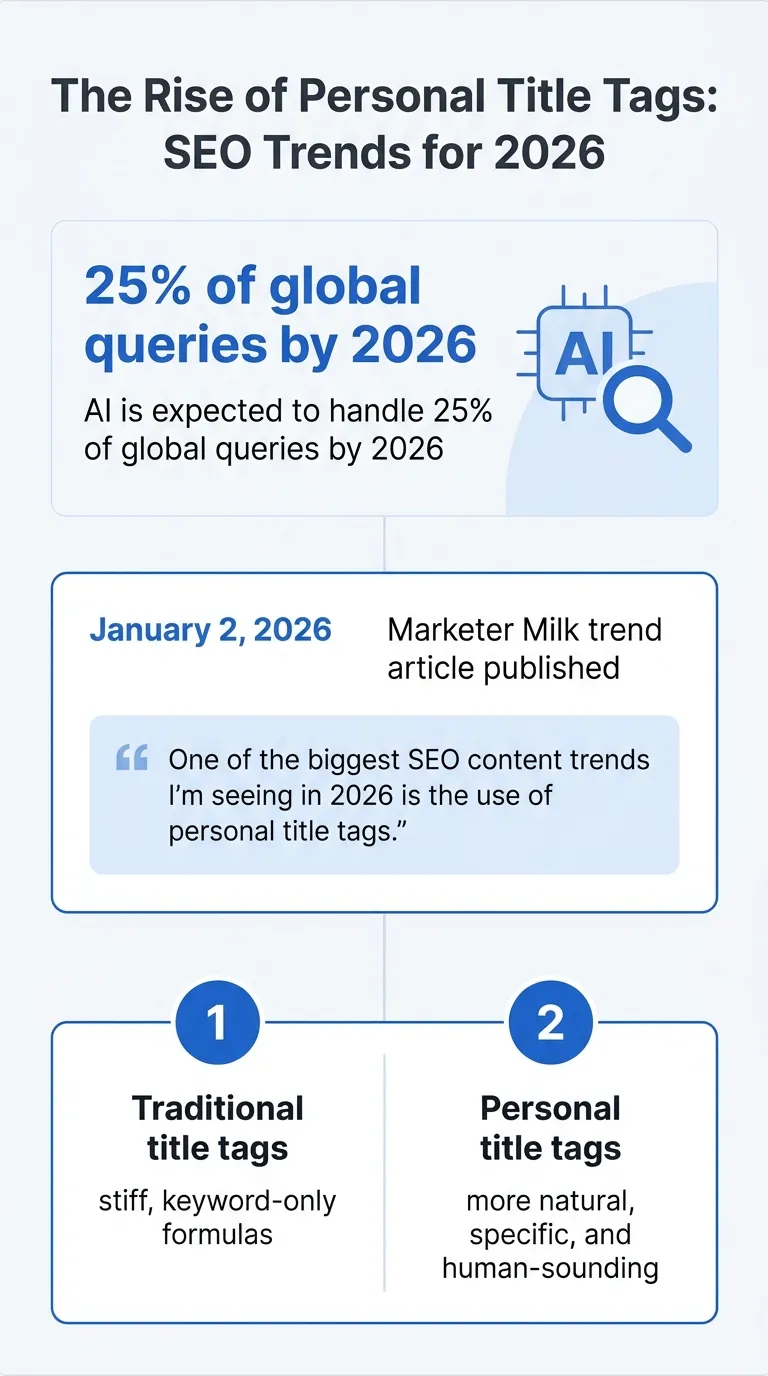
What the phrase points to is a real change in how marketers are writing page titles these days. Rather than using stiff, keyword-only formulas, more teams are testing titles that sound like a person wrote them, feel more specific, and give people a real reason to click. Most of the time, that means titles that sound more natural and less robotic.
That’s important for digital marketers, creators, agencies, and SEO teams because title tags still help shape first impressions, even as AI answers keep changing how people find content. The key question is no longer only “Did I include the keyword?” It’s also whether a real person would pick that result, which is often the more useful test.
In this article, we look at the latest thinking behind the trend, what it means for Google SEO tools and SEO tools for beginners, and how to test more personal titles without losing clarity, relevance, trust, or a natural feel. If the goal is to write titles that connect with people and still work for search, readers will probably find a few useful ideas here.
Why personal title tags matter for Google SEO tools
The recent interest in personal title tags comes from what SEO practitioners are saying, not from any Google announcement. In a trend article published January 2, 2026, Omid G wrote that “One of the biggest SEO content trends I’m seeing in 2026 is the use of personal title tags. Google is starting to look a bit more like YouTube.” (Marketer Milk) When that happens, the SERP can feel less like a simple list of links and more like a contest for attention on the results page, and that’s usually pretty easy to spot. A real one.
One of the biggest SEO content trends I'm seeing in 2026 is the use of personal title tags. Google is starting to become more like YouTube.
Omid G, Marketer Milk Tweet
Omid G also says he’s seeing more creator-style headlines taking up space on page one. But that doesn’t mean SEO basics are gone. People are just more likely to skip over bland title formulas without really noticing them. That shifts how agencies and editorial teams need to review title writing. A title now has to do two jobs at the same time. That sounds simple, but it often is not, and it can be a little frustrating. It should help systems understand the page, while also giving people a reason to click.
This is especially helpful for teams comparing Google SEO tools vs automated platforms. Tools can show impressions and clicks, but the biggest lift often comes from changing the message instead of only measuring it. So the shift isn’t only about tracking. In many cases, it’s about what the title actually says to the person seeing it.
The bigger context: AI search is changing what visibility even means
The rise of personal title tags makes more sense when you look at the bigger shift in search. Search is no longer mostly about ranking in a tidy list of ten blue links; that older view often doesn’t match how people find information now. According to Squarespace, AI is expected to handle 25% of global queries by 2026 (Squarespace). Adobe for Business explains the shift in a simple way: visibility will depend less on basic page position and more on whether a brand is mentioned inside AI-generated responses (Adobe for Business).
If you want pages that are easy to pull from, reliable, and straightforward for AI systems to summarize, titles still count, but they’re only one part of a much bigger visibility stack. A strong title tells people what the page is about and shows relevance quickly.
The future of SEO isn’t about ranking higher. It’s about becoming the answer.
Adobe for Business Team, Adobe for Business Tweet
That’s the context behind this title trend. If pages need to be easy to pull from, trustworthy, and simple for AI systems to sum up, titles still matter, but they sit within a much wider visibility stack. A strong title helps frame the page clearly and show relevance fast. Short and important, which is likely the point. It also sets expectations for the click and can support a clear point of view, which matters even more now that generic AI copy often floods the web.
For people using SEO tools for beginners, this usually calls for a real mindset shift. They may be optimizing a field in a CMS, but they’re also shaping the opening line of a page’s pitch for both people and machines. That’s a helpful way to see it, especially when the goal is to make a page easier to understand at a glance.
What personal title tags and Google SEO tools look like in practice
A personal title tag isn’t sloppy, vague, or just an excuse for fake hype. A simple way to describe it’s this: it keeps the main keyword theme, but adds more voice, more detail, and a little curiosity than the old keyword-only formula, which can honestly feel pretty stiff.
For example, a traditional title might be: ‘Best Google SEO Tools for Beginners.’ It’s clear, but it also feels a bit flat. A more personal version could be: ‘I Tested Google SEO Tools for Beginners: What Actually Helped.’ The topic is still obvious. What changes is how it feels. The second title shows experience, gives readers a clearer idea of the payoff, and adds some originality, which is usually where the difference comes from.
Marketer Milk points to this shift in a helpful way. Omid G wrote, ‘I see more “clickbait” titles showing up on the first page compared to traditional “SEO optimized” titles.’ (Marketer Milk) The key word is ‘more,’ not ‘only.’ That difference matters here. You’re looking at a trend, not some hard rule. It tends to work best for comparison posts, thought leadership, creator-led content, and case-study pages. On legal pages, product documentation, or high-risk YMYL topics, though, it’s usually a much worse fit, where precision often matters more than personality.
Neil Patel’s practical guidance works as a good guardrail here. Neil Patel says title tags should usually stay between 50 and 60 characters, with the sweet spot at about 580 pixels (Neil Patel). In plain terms, the title should sound more human, not just more chaotic. Make the main topic obvious, and be sure it matches the page people actually land on. Why? Because readers usually notice when a title promises more than the content really gives them. A good way to handle it is to keep it short and simple, skip stuffing exact-match phrases, and avoid promising anything the content can’t actually deliver.
Why human-sounding titles are getting more traction now
A big part of this is probably content saturation. AI has made it extremely easy to produce endless pages with nearly the same headline patterns, so titles that feel more real usually stand out more quickly, which makes sense here. Squarespace notes that demand for genuinely human-made content is rising because AI-generated material is now appearing almost everywhere (Squarespace). Omid G makes a very similar point: content with original insight and a more engaging angle is more likely to outrank generic AI material (Marketer Milk).
There’s also the question of traffic quality, and that matters here too. Adobe reported that AI-referred visitors view 12% more pages per visit and show a 23% lower bounce rate than non-AI referrals (Adobe for Business). Often, that points to a shift in the way people are discovering content. People might come in through summaries, recommendations, or answer engines, so once they land on the page, the title has to quickly feel relevant and trustworthy, especially in those first few seconds.
That’s when simple workflows for beginners start to matter more. A lot of beginner SEO tools focus on rankings, keyword use, and technical checks, and those still matter. But title testing, CTR review, and intent matching also need attention. If a page is ranking but still getting weak clicks, the title is probably the bottleneck.
For teams that need content support, SEO writing tools can help turn raw keyword targets into titles that sound more natural while still keeping the topic clear. Teams comparing broader optimization stacks may also want to review 2026’s Top SEO Audit Tools: Key Insights for Marketers, especially when title testing is tied to technical audits.
How to test this trend without falling into clickbait
The safest way to use personal title tags is usually to treat them as a test, since that’s often where they work best. Start with pages where voice can really help, like product comparisons, opinion pieces, tutorials, or original research, the more personal ones, really. Then compare a standard title with a stronger, more editorial version.
A simple framework often works well here. Nice and practical.
1. Keep the topic obvious
Start with the real subject. If the page is about Google SEO tools, don’t hide that behind a clever line, because that usually doesn’t help. Keep it clear for yourself.
2. Add a human signal
Words like “tested,” “learned,” “mistakes,” “actually,” or “what worked” can suggest firsthand value, when that’s really true and the content supports it. Simple, and often useful.
3. Stay accurate
Don’t oversell. A little curiosity gap is usually okay, I think. But false promises can hurt trust and damage long-term performance for you too.
4. Check length and snippet fit
Standard limits are a helpful guide. But when the title gets cut off, people can miss the key part, and that’s often the part that matters most.
5. Review click and engagement together
A higher CTR by itself usually isn’t enough if the page lets people down after the click, which happens pretty often.
When an agency is handling a lot of pages, the workflow can matter as much as the idea itself. So teams often use Search Console data alongside automated QA and content ops systems such as SEO Bot Software, especially when they need to test titles across bigger parts of a site and still keep everything consistent, which is usually the tricky part. Some teams also compare systems like Best SEO Automation Tools for Agencies Managing 100+ Client Sites when scaling title reviews.
What Google SEO tools mean for tool selection and daily SEO work
This trend should probably change how marketers think about tools. Most of the time, one dashboard that tries to handle everything isn’t the best setup, even if it looks simpler at first. Google SEO tools still matter because Search Console gives the clearest look at impressions, queries, and CTR. What they don’t show is which title style actually grabs attention from searchers. You usually figure that out through editorial judgment, careful testing, and sometimes a bit of AI help to draft a few options.
For beginners, it usually makes more sense not to build a huge tool stack right away. Start with the basics: Search Console, a simple process for testing titles, and a clear content brief. Then bring in more tools only when they solve a real workflow problem. Here, simpler often works better. One useful approach is to find tools that help spot weak pages, match H1s with titles, or update older posts at scale. And for a broader view of platforms for lean teams, SEO tools for agencies that need fewer logins is a helpful read.
More advanced teams should look beyond rankings alone. The title tag now sits inside a bigger system that also includes internal linking, schema, content structure, and AI citation readiness, and that’s easy to miss. Seen that way, the bigger picture matters more now. SEO Bot Software comes up in that broader workflow discussion as a WordPress-based resource for teams comparing AI-powered SEO automation, content systems, and technical optimization paths. For example, some teams combine title testing with resources like Best SEO Optimization Tools for AI Search Visibility and AI SEO Tools for GEO Tracking and AI Visibility to understand how AI-driven visibility changes search behavior.
Frequently Asked Questions
What is a personal title tag in SEO?
People in the industry use the term for a title tag that reads more like a person wrote it and less like a plain keyword headline. You still want the topic to be clear, just with a bit more voice, detail, or a better reason to click.
Are personal title tags an official Google ranking factor?
No. There’s no official Google announcement that says “personal title tags” are a ranking factor. It’s a term people in the field use after noticing how titles shift in tougher, AI-shaped search results.
Do title tags still matter if AI answers are taking more clicks?
Yes. Your title tag still affects how the page shows up in search results, and users use it to decide pretty fast whether it fits. It also makes the page clearer, which helps both people clicking and machines making sense of it.
What is the safest title length to aim for?
Around 50 to 60 characters usually works well, but what actually shows depends on pixel width, not a hard character count. Lead with the main topic, and leave off extra filler at the end.
Which Google SEO tools help test title tag performance?
A good place to start is Google Search Console, since it shows impressions, clicks, CTR, and query data for each page. So it’s a solid first step.
Many teams also pair it with workflow platforms like SEO Bot Software to review titles across many pages, tie title updates to content changes, and handle recurring SEO tasks in one process.
What are the best SEO tools for beginners if I want to improve titles?
Start with tools that help you understand search intent, page performance, and snippet clarity before paying for advanced extras. That’s the smart first step.
Beginners can get real value from Search Console, a simple spreadsheet for title tests, and trusted learning resources such as SEO Bot Software to compare automation options and practical SEO workflows.
Put this trend to work before your titles go stale
The rise of personal title tags points to a bigger shift. Search is becoming more selective, more shaped by AI, and more influenced by attention patterns that often feel closer to creator platforms. That doesn’t mean classic SEO is disappearing. Not at all. But it does suggest the old habit of writing stiff, interchangeable titles probably matters less now.
There’s a straightforward way to handle it. Write titles that are clear and relevant, lead with the main topic, and give people a real reason to care instead of some vague promise. If you’re in digital marketing, that usually comes down to trying stronger editorial angles in the headline itself. Agencies can build title review into the usual workflow, whether that happens in content briefs or during final QA. Creators, meanwhile, can bring experience and original insight straight into the headline. It’s simple, but still worth paying attention to here.
If you’re working with Google SEO tools or looking at SEO tools for beginners, title tags shouldn’t be treated like a tiny technical detail. They work more like smart packaging for your best pages, especially the ones you want people to click from search. In this kind of search environment, the strongest title is often not the one that looks the most optimized. It’s the one people understand fast and still want to click, especially when they are scanning results in just a few seconds.