TLDR; Need the quick version on SEO bot software? It’s a broad set of automation tools for repetitive SEO work: keyword research, content briefs, internal linking, technical audits, schema checks, reporting, and AI-search visibility tracking.
Best fit: agencies, in-house SEO teams, publishers, and small marketing teams. SEO now means ranking in classic search and showing up in AI answers, so pick tools that support both. Don’t treat any bot like a magic button: keep human review, match it to your workflow, and start with one narrow use case.
If your days are packed with audits, briefs, rankings, and content updates, the real SEO problem usually isn’t a lack of ideas. It’s a lack of time. There are just too many pages to review, too many keywords to sort, and far too many small fixes that keep slipping down the priority list, which probably sounds familiar. That is where SEO bot software can help.
SEO bots don’t all refer to the same kind of tool. It’s a broad term for software that handles parts of SEO using rules, AI, or more advanced agent-style workflows. Some crawl a site and flag technical problems like broken links or missing metadata. Others put together content briefs or tighten up internal linking, which can save a lot of manual clicking around. Some tools also monitor how a brand appears in AI-generated answers, not just in traditional search results.
That matters because SEO now has to work in two places at once. One is classic search. The other is discovery through AI. This guide breaks down what SEO bot software actually does, where it helps most, where it can cause problems, and which teams often get the most value from it. So for anyone trying to scale SEO without adding endless manual work, this is the part to understand first.
What SEO Bot Software Really Means
When people hear “bot,” a lot of them still picture shady tactics, but that view is pretty old at this point. Most modern SEO bot software is built to automate actual SEO work, not to game search engines. It’s better understood as a system that takes repetitive work off someone’s plate and gets it done faster than doing it all by hand, which is usually where things start to bog down.
Today, that can include a pretty wide spread of work: keyword clustering, content outlines, title tag testing, internal link suggestions for pages on a site, schema support, crawl monitoring, reporting, and even pushing updates live. That’s a broad mix, honestly. Newer tools are also moving past basic dashboards that only point out what to do. More of them can now take action directly, and that’s often the biggest change here.
That shift is happening because the search market is changing fast. In a June 2025 survey, 68% of organizations said they were actively changing search strategies because of AI search, and 54% said SEO and digital marketing teams were leading that work (BrightEdge). Around the same period, 91% of respondents in a 2025 SEOFOMO survey said decision-makers or clients had asked about AI-search visibility over the previous year (SEOFOMO).
+90% of participants say they were asked about the company’s AI Visibility over the last year. AI is a topic for everyone. And the weakest answer you can give is ‘just do good SEO’, even if that might be true!
Kevin Indig, SEOFOMO Tweet
So that’s why the term SEO bot now often overlaps with AI SEO tools, SEO automation software, AI-search optimization platforms, and similar systems. In most cases, people mean tools that don’t just report on SEO work, they also help do the work.
What an SEO Bot Can Automate Day to Day
One of the easiest ways to understand an SEO bot is to look at the work it can take off your plate. Most tools don’t do it all, but the better ones usually handle a few different parts of the job, and that’s a big part of why they’re useful. In practice, they mostly take care of the repetitive work that eats up time before the real decisions start.
Research and Content Workflows
One of the biggest is research automation. Bots can pull keyword ideas, sort them by intent, and turn messy lists into topic clusters. That kind of sorting tends to take longer than it should, so automating it can save hours before content work starts.
Another common use is content workflow automation. Bots can create briefs, suggest headings, recommend entities to include, and even draft sections for editors to review and improve. That’s already pretty normal. In 2025, 67% of marketing professionals said they used AI for automated content creation. Another 33% said better content quality was a main reason they adopted AI, which shows how practical this has become (eMarketer).
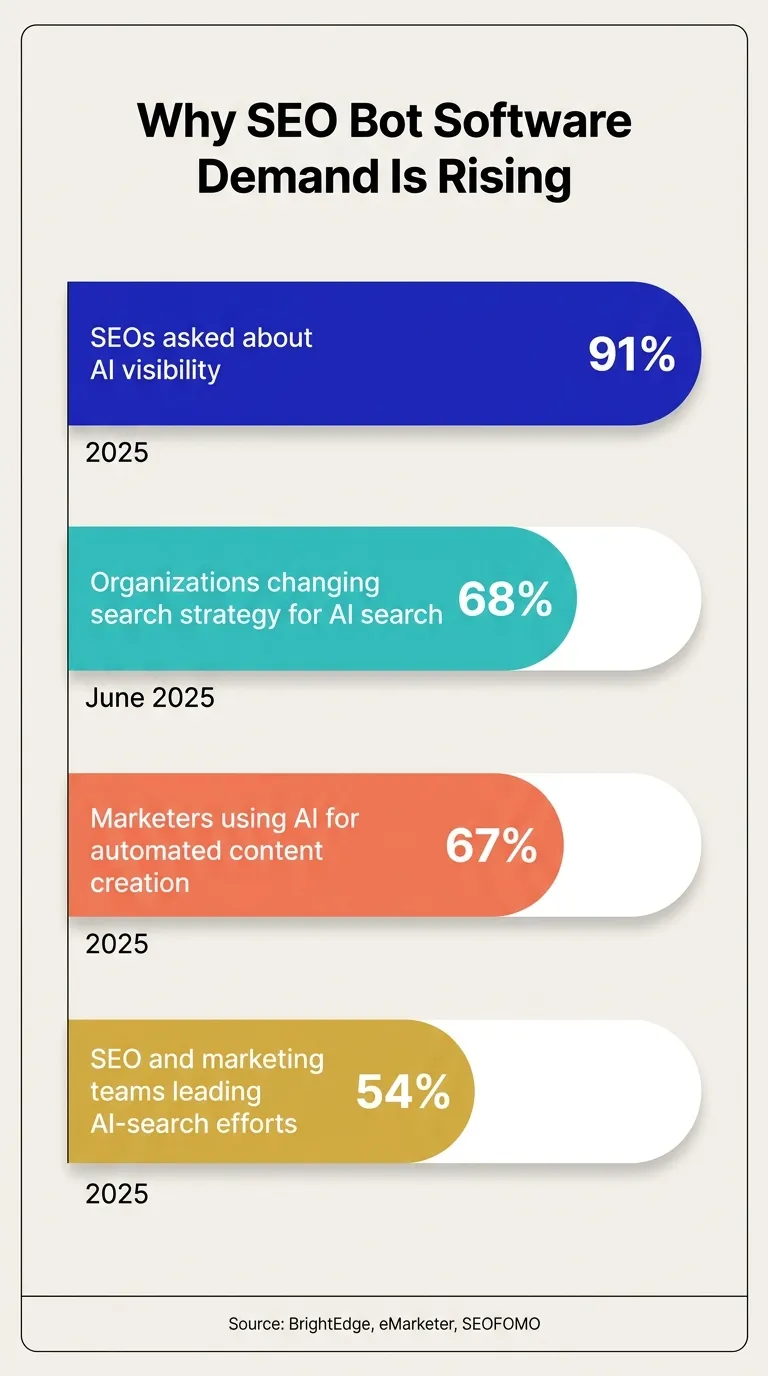
| SEO automation task | Survey figure | Period |
|---|---|---|
| Organizations changing search strategy for AI search | 68% | June 2025 |
| SEO and marketing teams leading AI-search efforts | 54% | 2025 |
| Marketers using AI for automated content creation | 67% | 2025 |
| SEOs asked about AI visibility | 91% | 2025 |
Technical SEO and AI Visibility
Then there’s on-page and technical automation. An SEO bot might suggest title changes, flag missing schema, catch crawl issues, spot broken links, or surface indexation problems. Some tools also handle internal linking automation. On large sites, that’s often one of the most useful time-savers because it helps connect related pages across the site structure. Even so, it still gets ignored a lot. Teams comparing tooling for audits and crawl analysis may also want to review SEO audit software innovations transforming 2026.
A newer category is AI-search visibility tracking. These tools track whether your brand, pages, or facts appear in AI answers and summaries. That can be useful if you want to understand how visible you’re beyond standard search results. And if you want a broader look at where this category is going, that’s covered in SEO automation software for lean marketing teams. Teams focused on GEO workflows can also compare options in Best Automated SEO Software for GEO Teams.
Who Gets the Most Value From SEO Bot Software
Different teams need different kinds of SEO bots. The biggest gains tend to come when the work is repetitive, heavy, or spread across a lot of pages and clients, which is how SEO often looks in day-to-day work.
Agencies are a natural fit. They’re handling audits, reporting, optimization, and content support across many sites at once. A bot can make recurring work more consistent, reduce admin time, and keep teams from getting buried in browser tabs, spreadsheets, and exported reports. That’s often the point where the time savings become hard to miss.
In-house SEO teams can benefit too, especially on larger sites. Once a team is managing hundreds or thousands of pages, manual updates usually stop being realistic pretty quickly. Bots can help with recurring audits, schema checks, internal linking, and content refresh workflows, the kind of work that tends to keep piling up. This is especially useful when one team runs a very large site and can’t go back through every page by hand.
Content teams and publishers get a lot out of them when they need to move faster without letting quality slip. Bots can put together briefs and early drafts, but human editors still need to shape the final version. Google is fairly clear about this in its guidance: using generative AI isn’t automatically a problem, but publishing content at scale mainly to manipulate rankings can break spam policies, and AI output still needs accuracy checks (Google Developers).
Small marketing teams may get the most value per person because they often don’t have specialist headcount. A good SEO bot can help one marketer handle more without having to operate like a full agency, and that’s often the draw. It keeps the basic SEO work moving without needing to hire a different person for every task.
The worst fit is any team hoping for a magic button. SEO bot software is usually best used as a force multiplier, not a stand-in for strategy. If you’re comparing broader platform options, Top SEO Software for Small Teams and Agencies can help frame that decision.
What Changes in the AI Search Era
The main reason SEO bot software matters more now is pretty simple: clicks and visibility usually don’t work the way they used to. In March 2025, browsing analysis covering 68,879 Google searches found that an AI summary appeared in 18% of searches. When it did, users clicked a traditional result only 8% of the time, compared with 15% when no AI summary appeared, which is a clear change. They also clicked a link inside the AI summary in just 1% of visits (Benchr).
So SEO bots can’t just go after rankings anymore. They also need to support entity clarity and citation readiness, along with structured data and content that can appear directly in AI answers, not just in blue links. There’s probably more to manage now, and in many cases that changes how SEO work gets planned.
Even so, classic SEO is still the foundation. Conductor found that 91% of respondents said SEO helped website performance and marketing goals in 2024. Another 63% said Google AI Overviews helped traffic, visibility, or rankings after rollout (Conductor). So it still seems clearly important.
The practical move is to use bots for traditional SEO and AI visibility at the same time.
The role of the in-house (and agency) SEO in this new era of AI search is to align expectations with the senior leadership team and come up with a plan that balances AI-search readiness whilst not losing focus on core SEO initiatives.
Kevin Indig, SEOFOMO Tweet
Common Mistakes to Avoid Before You Buy
A common mistake is picking a tool because it’s getting attention, instead of seeing if it actually fits how the team works. An SEO bot can look impressive at first, but it usually doesn’t do much if the team can’t review, approve, and publish what it suggests inside the CMS or content process without extra friction. It may look great on paper, but in real use, that’s often where things begin to fall apart.
Another common mistake is trusting AI output too much. Google has said AI content doesn’t get any special ranking boost on its own. What matters is whether the result is helpful, original, and trustworthy (Google Search Central Blog). When a bot writes content, someone still has to fact-check it, clean it up, and make sure it shows real expertise. That step usually can’t be skipped.
Measuring the Right SEO Signals
Teams also often get stuck by focusing too much on older metrics. Rankings still matter, but they don’t tell the whole story anymore. It’s not just about position alone; branded mentions, AI citations, search appearance, and content coverage over time matter too.
A simple way to begin is to try an SEO bot on one narrow workflow first, like internal links, content refreshes, technical alerts, or another small repeatable task. That makes it easier to see the before-and-after before rolling it out further, and it’s usually a lot easier to manage.
If the work is more technical, Best AI SEO Software for Technical Teams is a strong companion piece to this article. Teams evaluating automation at scale may also find Best SEO Automation Tools for Agencies Managing 100+ Client Sites useful for comparing larger workflow setups.
How to Choose the Right SEO Bot for Your Team
Begin with the work that actually needs doing, not the name on the tool. Ask what’s eating up the most time for the team each week. When reporting is what keeps holding things up, reporting automation usually makes sense as the first move. When briefs or content updates are the bottleneck, it’s usually better to put the focus on content operations. And if crawl issues, schema work, or other technical fixes just keep stacking up, technical automation is probably the best place to start, at least early on. Usually, it works better to keep that first step simple.
Matching Tools to Workflow Needs
The next thing to look at is control. Good SEO bot software should give teams approvals, clear rules, and a way to see what changed. That often matters even more as tools become more agentic and start making changes directly on important pages. That matters a lot, especially when multiple people are on the same team, which is pretty common.
After that, check whether the tool matches the way search works now. In 2025, 69.2% of surveyed organizations said they used SEO tools in their martech stacks, and 68.6% said they used generative AI tools (Martech.org). In many cases, the best setup is probably a connected workflow, not one huge platform, combining technical SEO, content automation, and AI-search monitoring.
For teams that want a WordPress-focused place to compare these workflows, this AI SEO tools resource hub is a useful resource with reviews, tutorials, and AI-driven SEO tool insights. It’s especially helpful when the work involves technical audits, content automation, or newer GEO-style visibility goals, which are often the tougher parts.
Frequently Asked Questions
What is SEO bot software in simple terms?
SEO bot software handles SEO work automatically, using rules, AI, or a mix of the two. It’s pretty simple. It can help with things like audits, keyword grouping, content briefs, on-page updates, internal linking, and reporting.
Is an SEO bot safe to use?
Yes, if it’s used for real optimization work and human review stays in place. Things go wrong when teams start pushing out bad AI copy at scale, or when they use automation mostly to game search rankings.
Who should use SEO bot software first?
Agencies, in-house SEO teams, content publishers, and lean marketing teams tend to see the payoff first. They do the same kind of work often enough that automation gives them real time back every week.
Can SEO bot software help with AI search visibility?
Yes. A lot of newer tools don’t just follow classic rankings anymore, they also track brand mentions, citations, and how visible you are in AI-generated answers. So they’re helpful for teams adjusting to AI Overviews, ChatGPT, and similar discovery tools.
How do I know which SEO bot fits my workflow?
Begin with whatever is slowing things down the most. If audits or fixes are where the team gets stuck most often, start with technical automation, that’s usually the easiest entry point.
When content production and refreshes are the bigger pain point, go with tools built for briefs, optimization, and editorial review instead. SEO Bot Software helps compare options by workflow instead of choosing blindly by brand name.
Is SEO bot software a replacement for SEO experts?
No. It takes repetitive work off your plate, but it doesn’t replace judgment, brand knowledge, strategy, or expert input. The AI SEO automation resource hub at SEO Bot Software works best when experts use it to speed things up and make better calls, not when they expect it to handle SEO on its own.
Put SEO Bots to Work the Smart Way
SEO bot software is most useful when you treat it like leverage. It helps teams do more of the work that matters without as much manual effort. In practice, that can mean faster audits, cleaner internal links across related pages, better briefs, stronger reporting, and a clearer view of AI-search visibility.
The point isn’t to automate just to automate. It’s about using automation for a specific job. A good SEO bot should handle the parts of your workflow that are slow, repetitive, or easy to standardize, because that’s usually where time slips away. It should help the team work better without creating extra noise. That’s what you’re trying to get to.
For an agency, a content team, or an in-house SEO lead, a practical next step is to map current bottlenecks and test one workflow first. Begin with one small workflow, track what changes, and build from there, because teams usually learn quickly once they see results. That’s often where automation starts leading to real SEO progress, like better internal linking across a group of related pages.