TLDR; Need the fast answer on AI search visibility? Semrush is the best all-in-one pick. Ahrefs wins for backlinks and competitor research, Surfer SEO for fast, scalable content optimization, and Clearscope for premium editorial quality.
Pick based on your biggest bottleneck: technical audits, authority building, content production, or reporting. Start with one clear goal, use one tool well, and measure progress over time instead of chasing the longest feature list.
Picking the right SEO optimization tools used to be mostly about rankings, keywords, and backlinks. That still matters, of course, but it’s not the whole picture anymore. Now brands also want to know whether they appear in AI-driven answers, summaries, and search experiences that pull from many sources at once, which is a pretty big shift. That is why this comparison matters right now.
To narrow things down, we looked at four widely used SEO software platforms that help with AI search visibility: Semrush, Ahrefs, Surfer SEO, and Clearscope. These aren’t random picks. They’re established tools used by agencies, in-house teams, and content marketers who need better workflows, not just more dashboards to click through. For a lot of teams, that usually comes down to something simpler: fewer steps, clearer data, and tools they can use without much hassle.
The best SEO tools now need to do more than just track rankings. They should help with technical health, improve content quality, spot entity and topic gaps, and show teams more clearly how a brand shows up across search results, AI summaries, and answer engines, not just Google by itself. It’s a simple idea, but often a helpful one. If a team is comparing top SEO optimization tools, this guide will probably help them choose based on fit instead of hype.
What you’ll find in this SEO optimization tools guide
- Semrush
- Ahrefs
- Surfer SEO
- Clearscope
Why AI search visibility changes the SEO optimization tools decision
Classic SEO still counts, and AI search is one more thing to account for. Pages tend to do better now when search systems can crawl them easily, make sense of them quickly, and pull from them for citations or summaries. So the tool stack has to tie technical SEO, content depth, and visibility tracking together in a way that actually works, not just looks good on paper.
More teams are choosing software that reduces the manual work involved in audits, optimization, and reporting. Looking at broader market signals from the first half of 2026, demand for SEO software was still rising. A lot of businesses were already using more than one tool, rather than expecting one platform to do audits, content work, and reporting equally well.
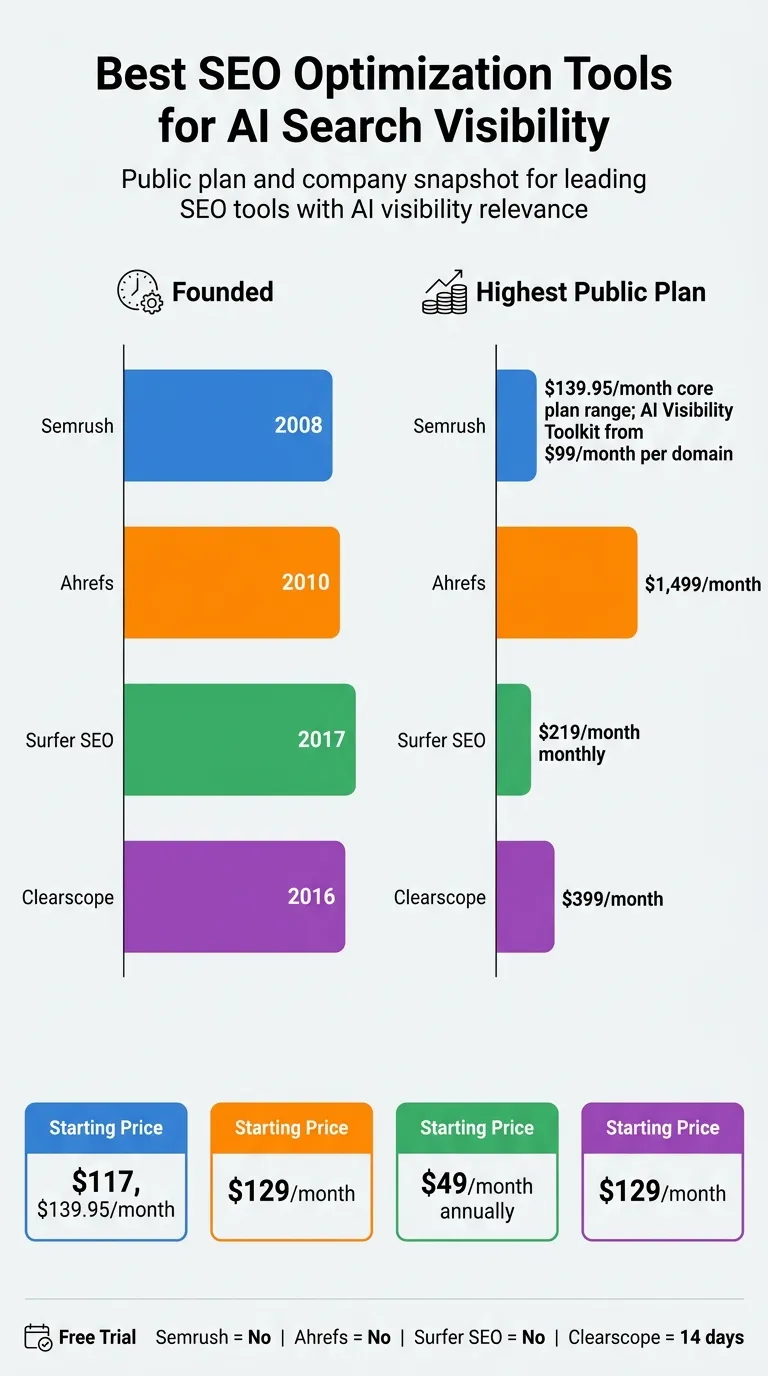
When pricing and founding dates are compared side by side, the category split becomes pretty clear, and honestly, pretty quickly. You can usually see the difference between broad suites and more specialized content tools, which helps when the goal is to narrow the options.
Public plan and company snapshot for leading SEO tools with AI visibility relevance
| Tool |
Founded |
Starting Price |
Highest Public Plan |
Free Trial |
| Semrush |
2008 |
$117, $139.95/month |
$139.95/month core plan range; AI Visibility Toolkit from $99/month per domain |
No |
| Ahrefs |
2010 |
$129/month |
$1,499/month |
No |
| Surfer SEO |
2017 |
$49/month annually |
$219/month monthly |
No |
| Clearscope |
2016 |
$129/month |
$399/month |
14 days |
Those numbers matter because they point to something more specific: the best SEO software for AI search visibility isn’t always the one with the longest feature list. More often, the better pick is the one that matches the workflow, the budget, and the main bottleneck, whether that’s technical audits, content optimization, or reporting cadence. That’s often the more useful way to decide.
Teams comparing broader SEO optimization tools can also look at resources like SEO Optimization Software: Analytics Tools Guide when narrowing down which platform best fits their reporting and workflow needs.
Four SEO optimization tools to look at
Semrush
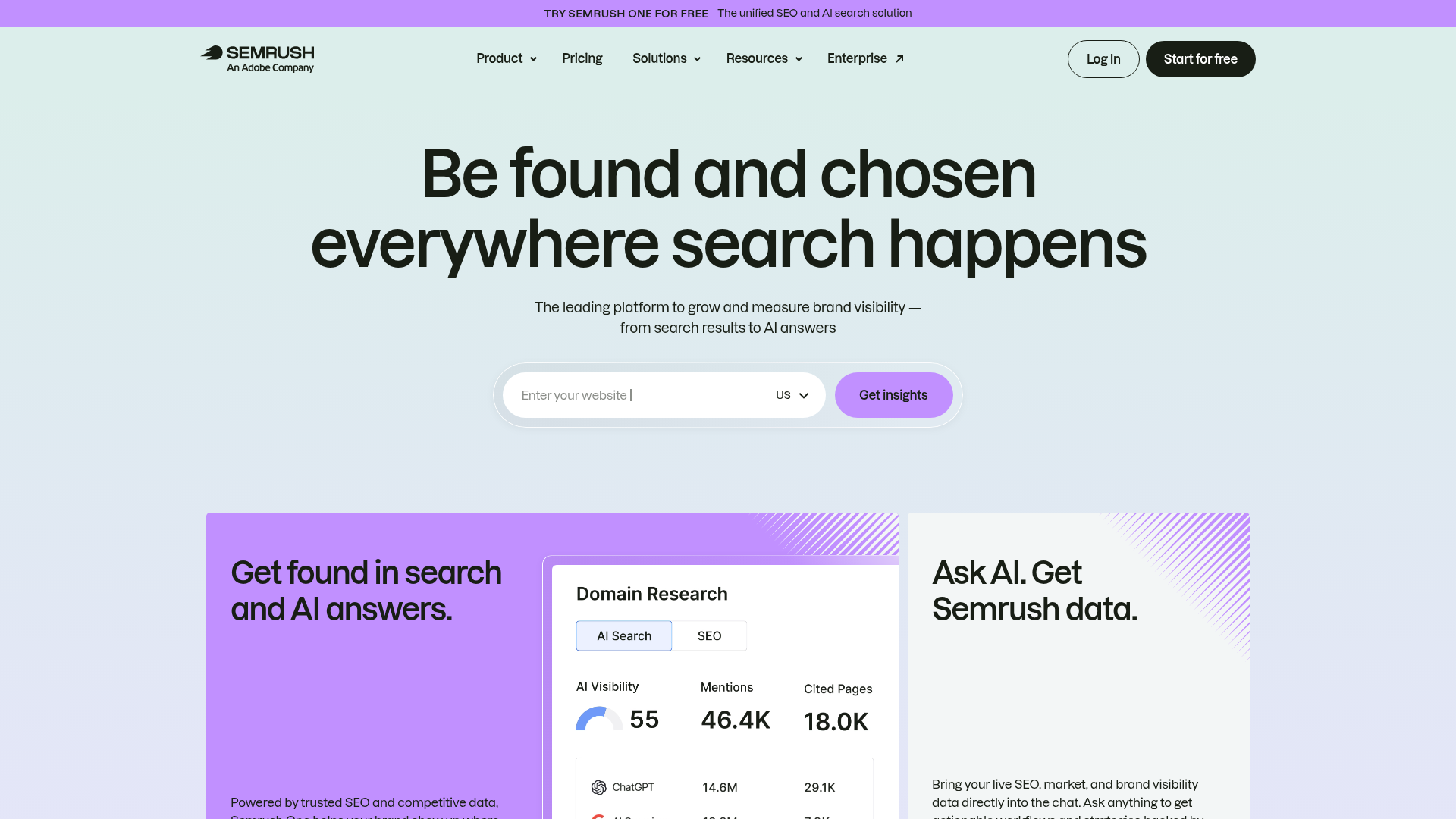
At a Glance
Semrush is probably the broadest all-in-one platform in this roundup. It puts keyword research, technical audits, backlink tracking, competitor research, rank monitoring, and newer AI visibility features into a single place. For teams that want one system to connect a lot of SEO work, it’s often one of the easiest places to start, especially when too many separate tools are already in the mix. Pretty straightforward. Its newer AI Visibility Toolkit also adds value for brands that want to understand how they appear in AI-driven search experiences as well as in traditional search results.
Core Features
Who It’s For
Semrush works well for agencies, in-house SEO teams, and growth-focused brands that want one main SEO platform with enough room for technical work, research, reporting, and AI visibility. That’s a lot under one roof, and that breadth is really the point. In many cases, it works especially well when shared reporting matters and when cutting down on tool sprawl matters more than keeping everything ultra simple. If a team needs technical audits, competitor tracking, and client-ready reports in one dashboard, it’s often an easy option to look at.
Unique Value Proposition
Semrush stands out mostly because it covers so much. Rather than zeroing in on one slice of SEO, it ties rankings, content, competitor data, and AI search visibility together in one system. So teams get a wider view of search performance without bouncing between platforms. If the workflow gets messy because the data lives in too many tools, Semrush can often cut down that friction and make reporting and research easier to manage. More than anything, that wide coverage is the main reason people look at it.
Pricing: Core plans are commonly listed from about $117 to $139.95/month, and AI Visibility Toolkit pricing is reported from $99/month per domain billed annually.
Website: https://www.semrush.com/
Ahrefs
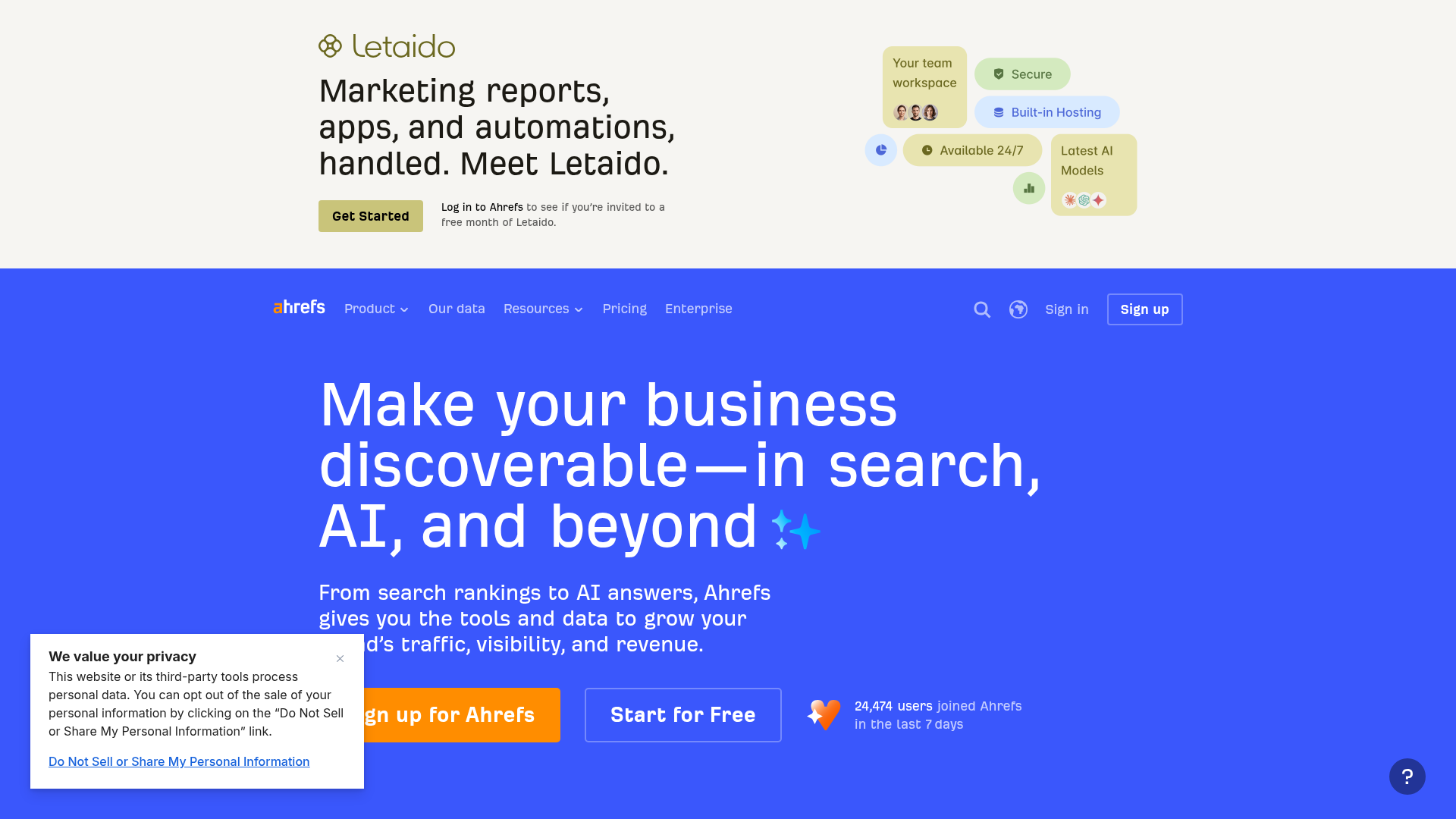
At a Glance
Ahrefs remains one of the top SEO tools for backlink intelligence and competitor research. A lot of agencies and seasoned SEO teams still rely on it because the data goes deep, the interface is straightforward, and the research tools support real decisions, which is usually what matters. It also now includes brand and visibility monitoring features for AI search visibility. Even with that, it’s still most useful for understanding authority, finding topic gaps, spotting backlink patterns, and seeing where competitors are performing well in search results and across their content.
Core Features
Who It’s For
Ahrefs works especially well for SEO professionals focused on backlinks, content gaps, and competitive strategy. That’s really the heart of it. If an AI visibility plan depends on building authority and understanding what already earns citations in a niche, Ahrefs gives teams a very strong research base. It’s probably best suited to teams that already know what questions they want the data to answer.
Unique Value Proposition
Ahrefs stands out when the main question is, “Why is another site winning?” It helps teams break down search success through links, keywords, pages, and content patterns. That often carries over into AI search as well. Strong source authority and coverage across a broad set of topics can help with citation potential, even when rankings aren’t the only metric that matters. This is often the point where Ahrefs helps most: showing what competitors are publishing, what gets links, and where your own coverage is thin.
Pricing: Pricing starts at $129/month and runs up to $1,499/month. That creates a fairly wide range. Some third-party reporting in 2026 also mentioned a $29 Starter plan.
Website: https://ahrefs.com
Surfer SEO
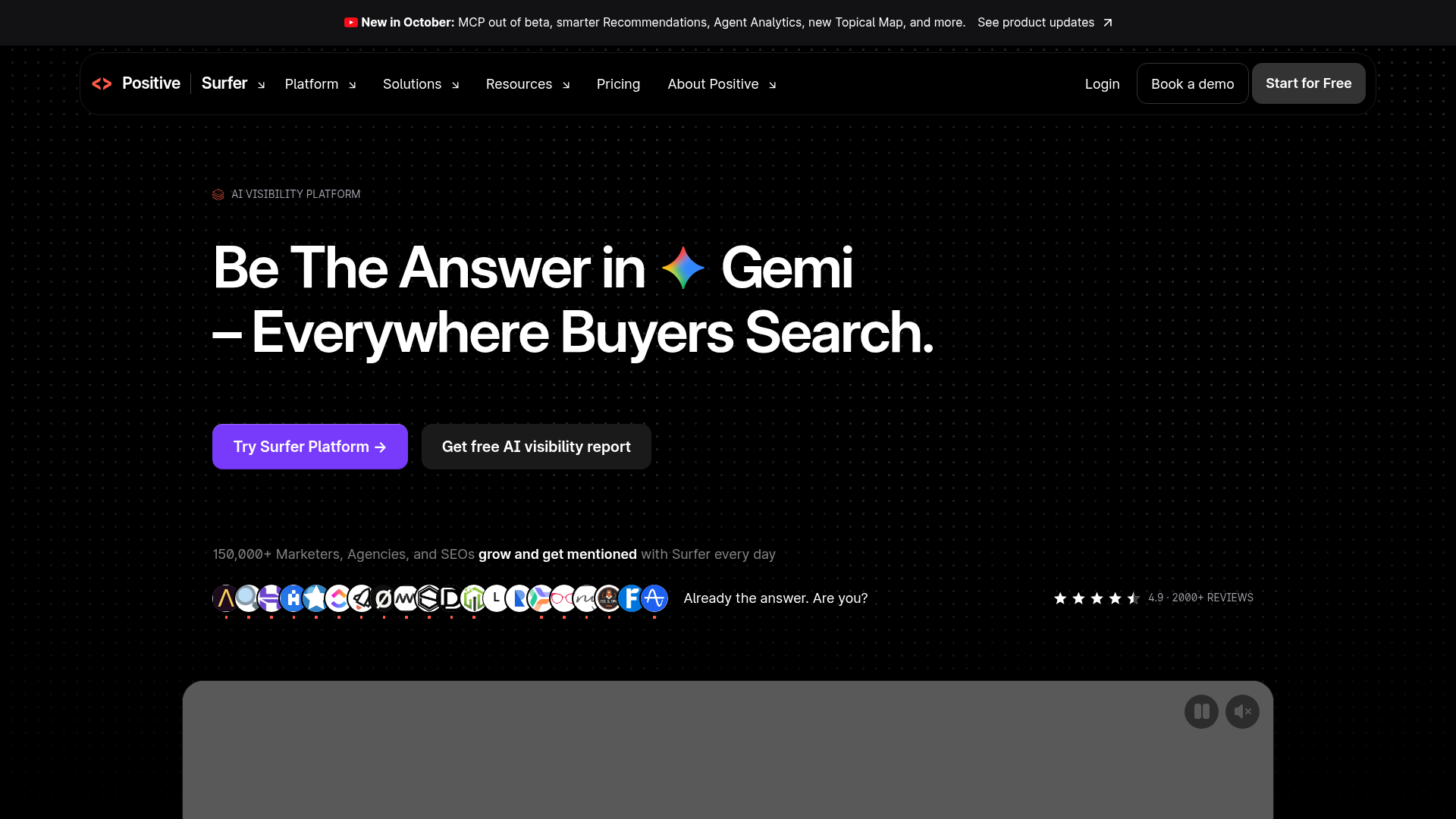
At a Glance
Surfer SEO is built more for content workflow than for running a complete SEO suite. It’s especially useful for teams publishing a lot and wanting clearer direction while drafting, optimizing, or updating pages, which is usually the main reason people choose it. Pretty practical, honestly.
It brings together SERP analysis, content scoring, AI recommendations, and newer AI visibility and prompt tracking features in one place. That said, it won’t replace a deep technical SEO platform or a backlink research tool. For writers, editors, and marketers, though, it can make content operations faster and usually more consistent, which saves real time.
Core Features
Who It’s For
Surfer SEO works well for content teams, publishers, and agencies that need to create or update pages at scale. When the main problem is getting from strategy to optimized pages more quickly, Surfer is often handier than a broader suite. That feels especially true for teams that care more about publishing efficiency than deep technical SEO work.
Unique Value Proposition
Surfer’s main value is the mix of speed and structure. Instead of guessing what “optimized” should look like, writers can build pages around actual SERP patterns and better topic coverage. In practice, you’re using search result patterns, recommended terms, and content scoring right in the editor to shape the draft. With AI search in the mix, that usually matters because clear structure, wider topical coverage, and semantic relevance make content more likely to be understood and reused by both machines and people, which is kind of a big deal right now.
Teams focused heavily on publishing efficiency sometimes compare Surfer with guides like Best SEO Copywriting Tools for Faster Content Ops to see which workflows better support editors and writers.
Pricing: Discovery starts around $49/month annually or $59/month monthly. Standard runs about $99/month annually or $119/month monthly. Pro is about $182/month annually or $219/month monthly.
Website: https://surferseo.com/
Clearscope
At a Glance
Clearscope is a premium content optimization platform with a clean, easy-to-use interface that’s built with editorial teams in mind. Rather than trying to be an all-in-one SEO suite, it sticks to helping teams create stronger, more relevant pages around a topic. That narrower focus can work really well. It’s especially useful when the main issue is content quality, refreshing older articles, keeping editorial standards consistent, and managing a growing content library without letting it get messy.
Core Features
Who It’s For
Clearscope is a strong fit for editorial teams, publishers, and brands where content quality is the main thing driving growth. It tends to make the most sense when technical SEO is covered elsewhere, backlink analysis happens in another tool, and the main need is better content performance. That use case is fairly straightforward, and teams already publishing on a regular schedule usually see the value sooner.
Unique Value Proposition
What makes Clearscope stand out is that it keeps its focus narrow. Instead of trying to cover everything, it helps teams build pages that are more complete, easier to read, and more on-topic. In real use, that usually leads to better subtopic coverage, clearer structure, and drafts that don’t come across as thin or repetitive. That can make a real difference for AI search visibility, especially when those systems are choosing what to surface in results. They’re more likely to pull from content that covers a subject clearly and thoroughly without feeling vague, scattered, or padded. The result is usually content that’s clearer and more useful.
Pricing: Essentials is $129/month, Business is $399/month, and a 14-day free trial is listed on the pricing page.
Website: https://www.clearscope.io
How these tools compare where it counts
Comparing strengths across workflows
If the team is mainly focused on one thing, the decision is a lot more straightforward. Most teams, though, are usually balancing a few priorities at once: content output, authority, technical health, and visibility in AI-generated search experiences. Here’s a straightforward way to look at the four tools without overcomplicating it.
That difference usually matters in practice. AI search visibility usually isn’t the kind of thing one feature fixes on its own. In most cases, strong performance comes from clean site signals, source-level trust, and content that answers questions clearly. It may sound obvious, but that’s often the point where things start to slip. So the right choice comes down to which mix of needs matters most to the team and what it’s actually trying to improve.
For teams that prioritize audits and site health first, Best Technical SEO Tools for 2026: A Detailed Review offers another useful comparison alongside these platforms.
So which one should you pick?
Choosing based on team priorities
If you want one platform that covers SEO and AI visibility well, Semrush is usually the safest pick. It gives teams the broadest set of tools in this group and usually makes the most sense when research, tracking, and optimization need to live in one main system. That usually makes it a solid default, and it’s also a pretty easy choice to explain internally.
Ahrefs tends to be the better fit when the real edge comes from authority, backlink strategy, and competitor research. It’s especially useful for advanced SEO teams and agencies that spend a lot of time looking through link data and studying competitor moves. That’s usually where its clearest strength shows.
If producing content is what’s slowing things down, Surfer SEO is usually the most practical pick. It helps content teams get posts out faster and keeps optimization organized without creating too much extra work, which matters a lot for teams that publish regularly.
For a serious editorial workflow and a premium content optimization tool, Clearscope is the best match. It’s more specialized, but it performs very well in that area. If that’s how the team works, the difference is often noticeable.
There isn’t one winner for every business. The best SEO tools are usually the ones that match the workflow and help teams do something with what they find, instead of just piling up more data. So the best choice comes down to how the team actually works.
Turn your tool choice into real AI search gains
Putting SEO optimization tools into daily workflows
Picking software is just the beginning. What’s tougher is putting it to good use. Teams often buy SEO optimization tools for audits, content scoring, AI visibility tracking, and similar jobs, then hit a wall when they try to turn those reports into useful daily work, which is pretty common. That’s usually the point where the way you work matters more than one more feature on the list.
The simplest way to handle this is usually best. Start with one goal, like improving citation-ready content or cleaning up technical health. For some teams, tracking AI visibility on a few core pages first is often the easiest place to start. Small steps usually make this easier to handle. Use the tool you picked to measure that area, make a few changes, and see what shifts in performance. Once that starts working, it’s easier to keep going. In most cases, taking it one step at a time works better than trying to automate everything all at once.
If practical help with these tools would be useful, SEO Bot Software is a solid resource for reviews, tutorials, and AI-focused SEO guidance. It covers automation, technical SEO, content workflows, and Generative Engine Optimization in a way that’s easier to use, so it doesn’t stay stuck at the theory level. The broader learning hub at this WordPress-based SEO automation review platform can also help teams compare approaches and put together a tool stack that fits.
Teams trying to streamline large-scale client management may also find value in Best SEO Automation Tools for Agencies Managing 100+ Client Sites when evaluating workflow automation.
Frequently Asked Questions
What should I look for in SEO optimization tools for AI search visibility?
Begin with technical audits, content work, and tracking how visible you’re beyond standard rankings. Good SEO software should make it easier to improve crawlability, site structure, topical depth, and brand presence in AI-driven search results. It should also track more than keyword positions.
How do I know if an SEO tool is actually helping with AI search visibility?
Keep an eye on changes in branded search lift, assisted conversions, and organic traffic quality, along with how often your brand or pages show up in AI summaries or prompt-style results. Rankings still matter, but look at them alongside stronger trust signals and content coverage, not by themselves.
How much do the best SEO tools usually cost?
What makes more sense, an all-in-one suite or a specialized content tool, comes down to what you need. In this roundup, public pricing starts at about $49/month for Surfer SEO’s lower annual tier. At the top end, Ahrefs enterprise-level plans run up to $1,499/month. A lot of teams use a stack, so the total cost can end up higher than a single subscription.
Which businesses benefit most from these tools?
Agencies, SaaS companies, publishers, ecommerce teams, and service brands tend to get the most out of it, since they rely so much on search visibility. It’s particularly helpful for larger sites that publish often, and for teams trying to cut down on manual SEO work.
How long does it take to see results after switching SEO software?
You can often see workflow improvements pretty quickly, especially with audits, reporting, and content production. Traffic and visibility usually take more time to improve, since the fixes have to be made first and then crawled, indexed, and tested by search systems over time.
Where can I learn how to use these tools more effectively?
A comparison article helps with the choice. The real payoff shows up when a team actually uses it.
SEO Bot Software offers practical guidance for teams that are figuring out how to tie AI content workflows to technical SEO and GEO strategy, so the software they pick turns into measurable progress instead of just sitting there as unused features.